
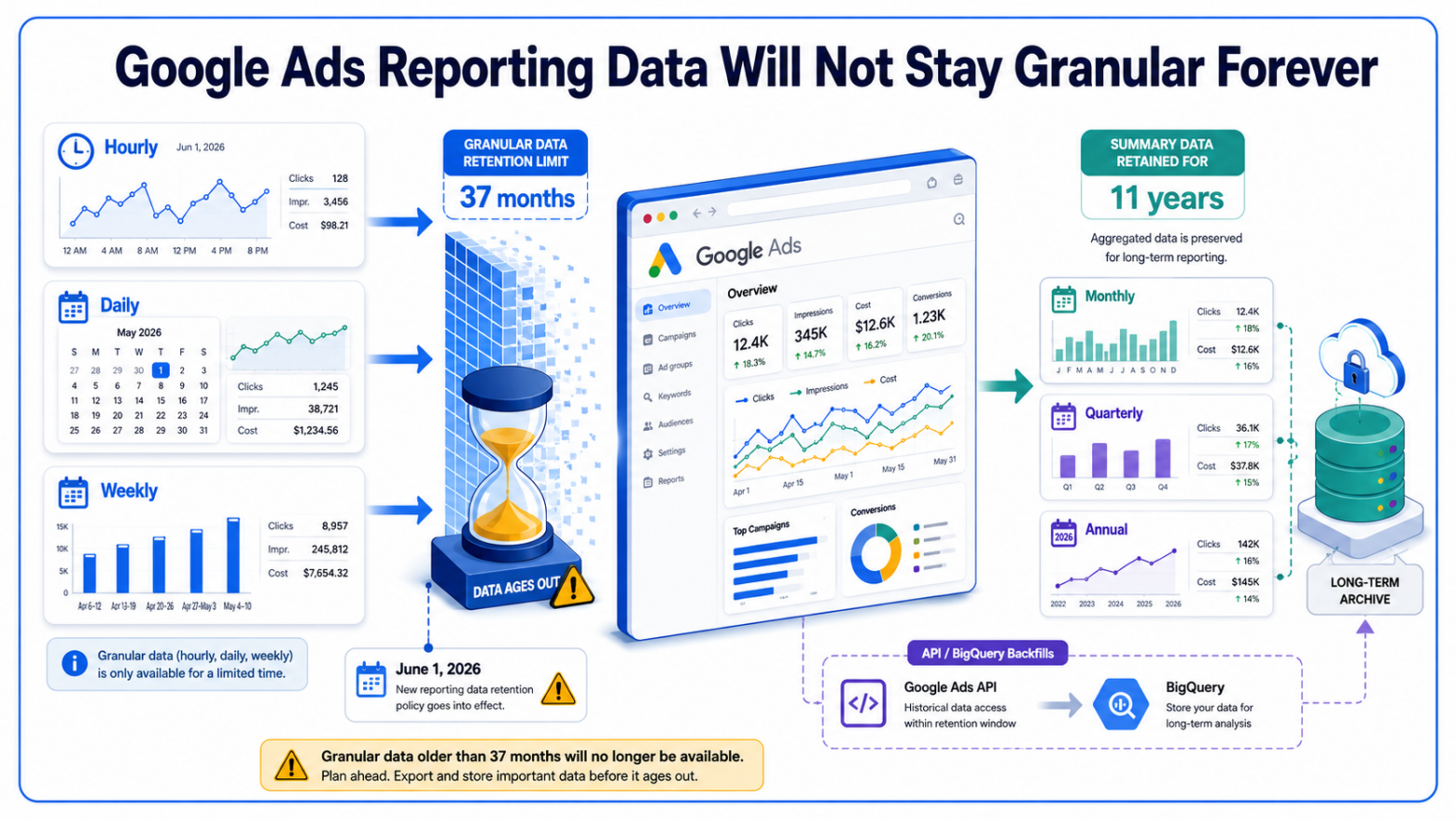
Google Ads reporting is getting a shorter memory.
Starting June 1, 2026, advertisers will no longer be able to rely on Google Ads as a permanent archive for older hourly, daily, and weekly performance data. The change affects the interface, APIs, and some BigQuery transfer workflows tied to Google Ads reporting.
The Most Detailed Data Gets The Shorter Window
Google’s updated Ads Help documentation says hourly, daily, and weekly reporting data collected for periods shorter than one month will be available for 37 months.
After that window closes, the data will not be accessible through the Google Ads interface or APIs.
That is the important line for agencies, in-house media teams, and advertisers with long campaign histories. A three-year monthly trend may still be visible, but the day-by-day pattern behind that trend may not be.
For accounts that use older daily data to review budget pacing, diagnose performance swings, compare promotional periods, or audit past campaign changes, the reporting workflow will need to change before the cutoff takes effect.
Monthly And Annual Reports Survive Longer
The new retention policy does not erase all long-term Google Ads reporting.
Monthly, quarterly, and annual data will remain available for 11 years. That gives advertisers a broader historical view, but with less diagnostic depth once the more granular data ages out.
A yearly report may show that cost per conversion changed. It may not show whether the shift came from a holiday spike, a landing page issue, a short-lived bidding change, or a few unusually expensive days.
That distinction matters because many paid search accounts are not managed only at the monthly level. Daily pacing and week-over-week movement often shape budget decisions long before a monthly report is reviewed.
Reach And Frequency Metrics Have Their Own Clock
Google also lists a separate three-year retention window for reach and frequency metrics.
Affected metrics include unique users, average impression frequency per user, seven-day and 30-day average impression frequency per user, and frequency distribution ranges such as 1+, 2+, 3+, 4+, 5+, and 10+.
That part of the policy is especially relevant for brand advertisers, video campaigns, YouTube planning, and media teams that review audience exposure over several years.
Performance marketers may focus first on the 37-month limit for daily and weekly reporting. Brand teams have a different issue: older exposure data may become unavailable even when broader campaign totals remain in place.
APIs And Backfills Are Part Of The Change
This is not only a user-interface update.
Google says data outside the applicable retention period will not be available through Google Ads APIs. Google Cloud documentation also says BigQuery Data Transfer Service connectors for Google Ads, Search Ads 360, and Google Analytics 4 will stop populating backfill runs for dates earlier than 37 months from the current date beginning June 1, 2026.
That makes the policy operational, not just historical.
Dashboards that query Google Ads live, scripts that pull old reporting on demand, and warehouse jobs that depend on backfills may return incomplete results once the relevant data falls outside the retention period.
Stored data already exported to an advertiser’s own warehouse is a different matter. The risk is in assuming Google Ads will continue to serve as the source system for older granular reporting whenever a team needs it.
The Archive Problem Lands With Advertisers
Google’s documentation points advertisers toward downloading reports, using the Google Ads API, or relying on linked analytics tools where applicable.
The practical issue is timing. Data needs to be exported before it ages out.
For marketers and SEOs working with paid search data, the change means historical reporting systems should be reviewed for how they store daily and weekly performance records. Accounts that need older data for audits, seasonality analysis, forecasting, client reporting, or budget planning will need an independent archive rather than a live pull from Google Ads.
The policy begins on June 1, 2026. From that date forward, Google Ads will still provide long-term reporting, but not always at the level of detail many advertisers use when they need to explain what happened inside a campaign.