OpenAI Expands ChatGPT Ad Platform to Include Performance-Based Pricing
Advertisers testing ChatGPT can now pay per click rather than per impression. OpenAI has begun offering ChatGPT advertising campaigns that charge advertisers based on how many users click ads, a shift reported April 21, 2026, alongside the company's first job posting for an advertising measurement leader.
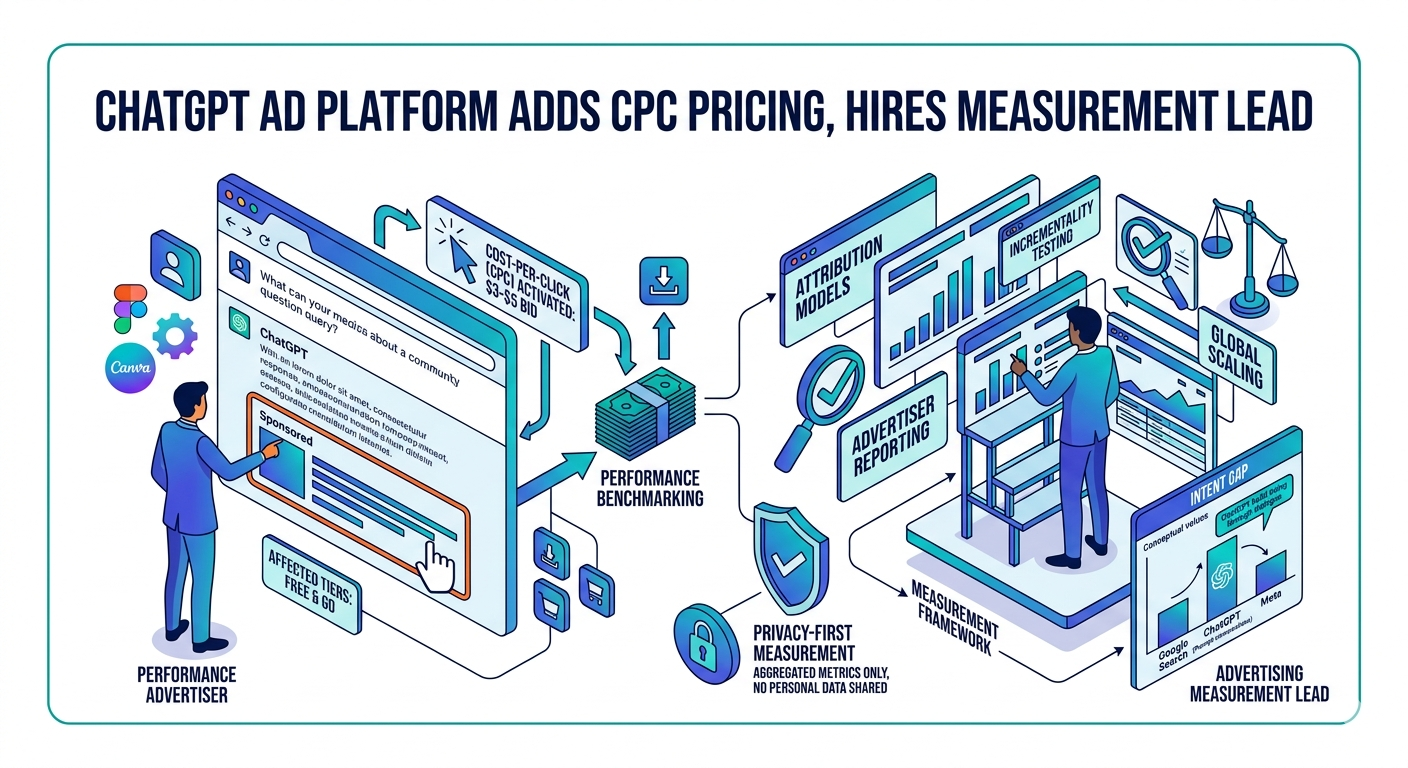
The change gives marketers currently testing advertising on the platform the option to pay when someone actually clicks, rather than for every thousand impressions served. Advertisers can set bids between $3 and $5 per click, according to screenshots of the ads manager verified by Digiday.
The move runs alongside a notable gap in OpenAI's advertising infrastructure. The company has not yet hired anyone to own its measurement function; the role it is now recruiting for would be its first.
Why CPM Pricing Was a Starting Point, Not a Long-Term Model
OpenAI launched ChatGPT ads in February 2026, with initial pricing set at $60 CPM. That structure was suited to brand advertisers who accept impression-based billing, but it excluded the larger segment of performance advertisers who require click-based accountability.
Claire Holubowskyj, senior research analyst at Enders Analysis, said: "OpenAI's experimentation with CPC is driven largely by its need to maintain demand growth and build trust with advertisers, though declining CPMs and an expanding pilot are also factors."
Advertising on ChatGPT has already been getting cheaper. The rate advertisers pay to reach every thousand users has dropped from $60 at launch ten weeks ago to as low as $25 in some cases, and the trend is downward. As CPM revenue declines, CPC gives OpenAI a second revenue pathway that does not depend on sustaining high impression prices.
Nicole Greene, VP and analyst at Gartner, said the pricing shift creates a direct line of comparison between ChatGPT and established ad platforms. "As OpenAI looks to increase spending, this is going to help advertisers directly compare their results on OpenAI to other major advertising platforms and manage their spend."
The Intent Gap: Where ChatGPT Sits Relative to Google and Meta
CPC pricing raises an immediate question about the value of a click on ChatGPT compared to clicks on competing platforms. According to digital ad agency Adthena, Meta's CPCs run three to five times cheaper than Google Search, not because the inventory is necessarily worse, but because the intent behind them is different. Social users are browsing; search users are actively looking for something. That intent gap is what allows Google to charge a premium per click.
Where ChatGPT's clicks land in that spectrum is not yet established. Ashley Fletcher, CMO at Adthena, which has several clients testing ads on ChatGPT, said: "LLMs are now starting to bridge that gap, as intent begins to build through the back-and-forth of prompt-driven conversations."
Aside from introducing cost-per-click pricing, OpenAI also hopes to offer campaign formats focused on driving users to take specific actions, such as downloading an app or making a purchase, though the timeline for that rollout remains unclear.
OpenAI Recruits First Advertising Measurement Lead
Concurrent with the CPC rollout, OpenAI has posted an active job listing for its first Advertising Marketing Science Lead, based in San Francisco. The role is described as establishing and scaling OpenAI's advertiser-facing reporting, measurement, and attribution credibility, with the successful candidate responsible for defining how advertisers understand performance on OpenAI and how its reporting aligns with existing measurement frameworks, including multi-touch attribution, incrementality testing, and media mix modelling.
The position will begin as a hands-on individual contributor role building the methodological foundations of OpenAI's advertising measurement system, with scope to define the strategy, operating model, and team needed to scale the function globally as advertiser adoption grows.
The role requires leading advertiser-facing measurement discussions, representing OpenAI in executive briefings, measurement escalations, and industry conversations while building trust in its methodologies and reporting. The successful hire will also shape OpenAI's external measurement ecosystem, working with third-party measurement partners, clean-room providers, and industry groups to align standards and reduce friction for advertisers.
Privacy is written into the brief from the outset. The role requires building a privacy-first measurement ecosystem in partnership with product, engineering, sales, partnerships, and legal.
OpenAI has stated that advertisers do not receive access to individual user conversations, chat history, memories, or personal identifying details, and that only aggregated performance metrics are provided to advertising clients.
Ad Placement and Tier Eligibility
The advertising rollout affects users on ChatGPT's Free and Go subscription tiers. Higher-tier subscriptions, including Plus, Pro, Business, Enterprise, and Education accounts, remain ad-free. This two-tiered approach creates a division between users who see sponsored content and those who pay for an uninterrupted experience.
Ads appear at the bottom of ChatGPT's responses in a clearly labelled "Sponsored" section with a visual border separating them from organic answers.
Implications for Performance Advertisers
For marketers currently evaluating ChatGPT as a paid channel, the addition of CPC bidding enables standard performance benchmarking against Google Ads and Meta campaigns. However, without a built-in attribution or conversion tracking system, which the newly posted measurement role is tasked with building, marketers should expect to rely on their own third-party attribution tools to evaluate return on ad spend during this period. The CPC bid range of $3–$5 positions ChatGPT below Google Search's typical CPC rates, but the relative value of each click will depend on the intent quality OpenAI can demonstrate through future measurement reporting.
The Information has reported that OpenAI has forecast $2.4 billion in ad revenue for 2026 and $11 billion for the following year, targets that depend heavily on retaining and scaling the performance advertiser segment that CPC pricing is now designed to attract.