
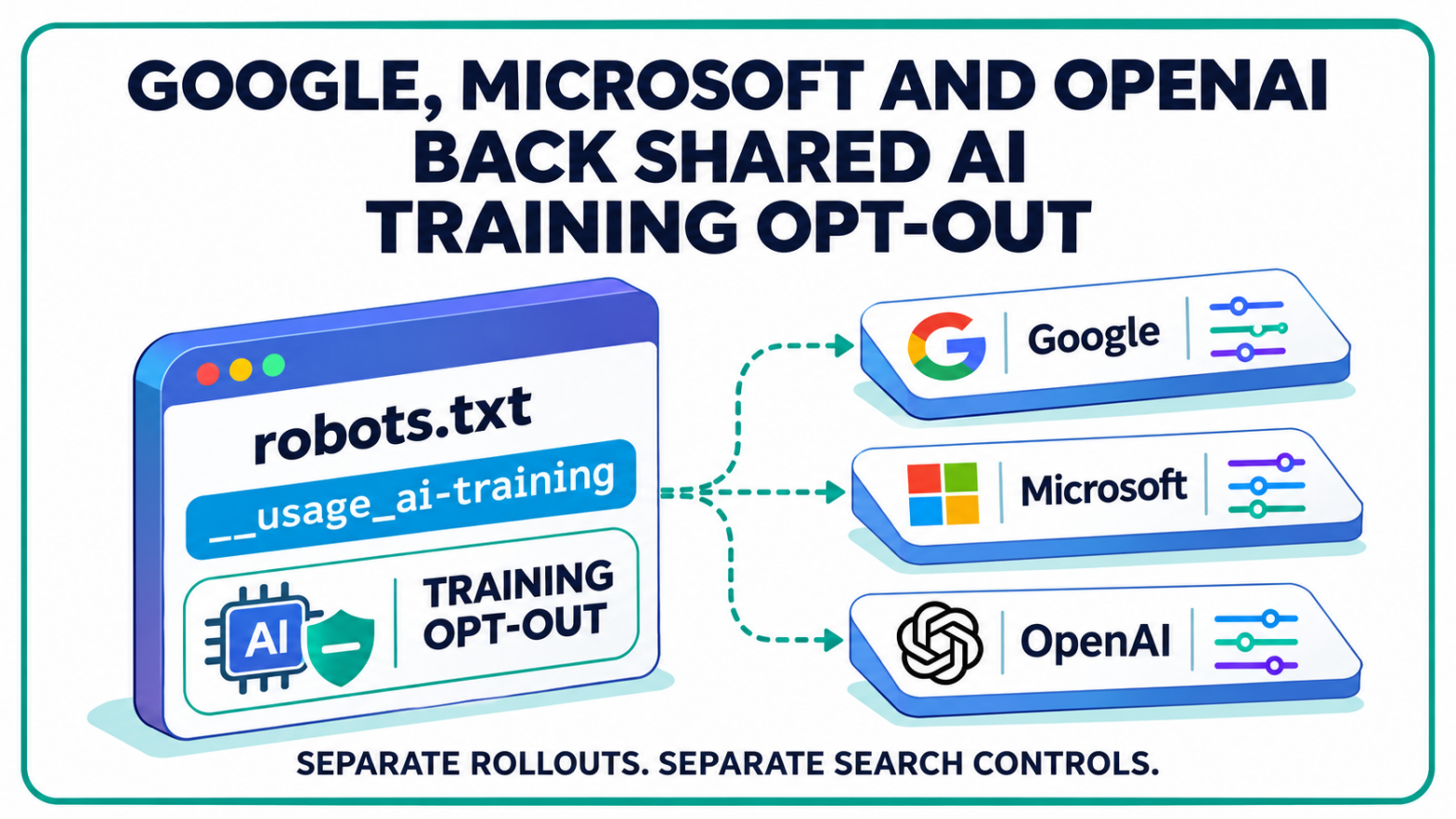
Refusing generative AI training is set to become simpler. Google, Microsoft and OpenAI have committed to supporting one shared robots.txt token, but their announcements leave publishers with separate decisions about crawling, search visibility and the content used in AI-generated answers.
The October 30 announcements back __usage_ai-training, a policy token that lets websites communicate training preferences across participating providers without maintaining a separate instruction for each company.
The agreement is shared. Implementation is not identical.
The AI Training Opt-Out Has Different Start Dates
The commitments do not establish that the shared control is already operating across all three companies.
Google’s announcement targets support in 2027. Its crawler documentation specifies early 2027, giving website owners a narrower implementation window without naming a launch date.
Microsoft will begin honouring its new training and grounding preferences on February 1, 2027, as it crawls content.
OpenAI’s announcement of shared training preferences says implementation is planned for the coming months. The company will publish another update explaining its implementation when support arrives.
For publishers, that timing separates an announced industry commitment from an active, cross-provider control. Publishing the token does not establish that every participating company has started processing it.
OpenAI describes the initiative as voluntary and encourages other AI providers to participate. Its reach therefore depends on adoption, rather than the presence of the token alone.
A robots.txt Preference Is Not a Crawl Block
The proposed mechanism uses familiar robots.txt formatting. The token identifies a content-use preference, not a particular crawler. Under the technical draft describing the mechanism, websites can also express preferences for individual paths. An Allow rule for /press-kit/, for example, can create an exception to a broader training restriction.
Existing wildcard groups do not substitute for the named token. A User-Agent: * group does not express the shared training preference, and a file without __usage_ai-training communicates no preference through this mechanism.
The token also does not itself instruct crawlers to stop fetching pages. Crawler-specific access rules remain separate.
That distinction is familiar from existing AI training opt-out tools: communicating how collected content may be used is different from preventing its collection. A publisher can restrict a covered use without necessarily closing the route through which search engines discover its pages.
Training and AI Answers Still Have Different Boundaries
The most consequential difference between the companies concerns grounding: supplying web content to help inform an AI-generated response when a user asks a question.
Google plans to connect the shared preference to Google-Extended. When a website publishes the shared training opt-out without explicitly specifying Google-Extended, Google intends to treat it as though the publisher had disallowed Google-Extended.
That existing control covers both future Gemini model training and specified grounding uses in Gemini Apps and Vertex AI. A broadly expressed training refusal can therefore affect more than model development under Google’s implementation.
Google’s explanation of the shared control says company-specific instructions will continue alongside it. Websites that explicitly allow Google-Extended remain eligible to appear through grounding in Gemini Apps responses.
Google Search has another boundary. Google-Extended does not affect inclusion or ranking in Search. Participation in AI Overviews, AI Mode and generative AI features in Discover is managed through the separate Search generative AI control in Search Console.
Microsoft takes a different approach. Training and grounding preferences are independent. Its page-level Disallow setting excludes grounding, while DisallowExtended permits grounding in Microsoft-operated experiences but excludes Microsoft’s grounding services supplied to third parties.
A shared training token consequently cannot be read as one uniform instruction about every provider’s AI answers.
Existing Crawler Controls Will Continue Alongside the Token
For OpenAI, the shared signal supplements existing controls rather than replacing them. Its announcement explicitly says current crawler controls will continue to apply and be respected.
Those robots.txt distinctions already let website operators address different purposes. OpenAI’s search crawler and training crawler have separate controls; allowing search access does not require allowing training collection.
Google likewise says its company-specific controls will remain available. Publishers will be able to express a broad preference through the shared token while retaining more specific instructions for Google.
The immediate practical implication for marketers and SEOs is configuration review, not a blanket crawler block. Teams need to distinguish the intended training policy from search access and AI-answer participation, then compare that policy with existing provider-specific settings and the announced implementation dates. Treating all three as the same permission risks changing visibility when the intended decision concerns training alone.
Microsoft Sets a March Deadline for Older Controls
Microsoft’s training and grounding announcement includes a migration requirement: NoArchive and NoCache will stop serving as training or grounding preferences after March 1, 2027.
Sites relying on those tags must publish replacement training preferences. Maintaining grounding restrictions also requires page-level preferences and a temporary choice in Bing Webmaster Tools.
That temporary option opens December 15, 2026, only for sites using the older tags on that date. It expires when Microsoft discovers the page’s new grounding preference through recrawling or on September 30, 2027, whichever comes first. There is no equivalent temporary training setting.
The shared mechanism itself remains a proposal. The IETF tracker lists its specification as an individual Internet-Draft, not an endorsed IETF standard; the current draft is dated October 30 and expires May 3, 2027.