

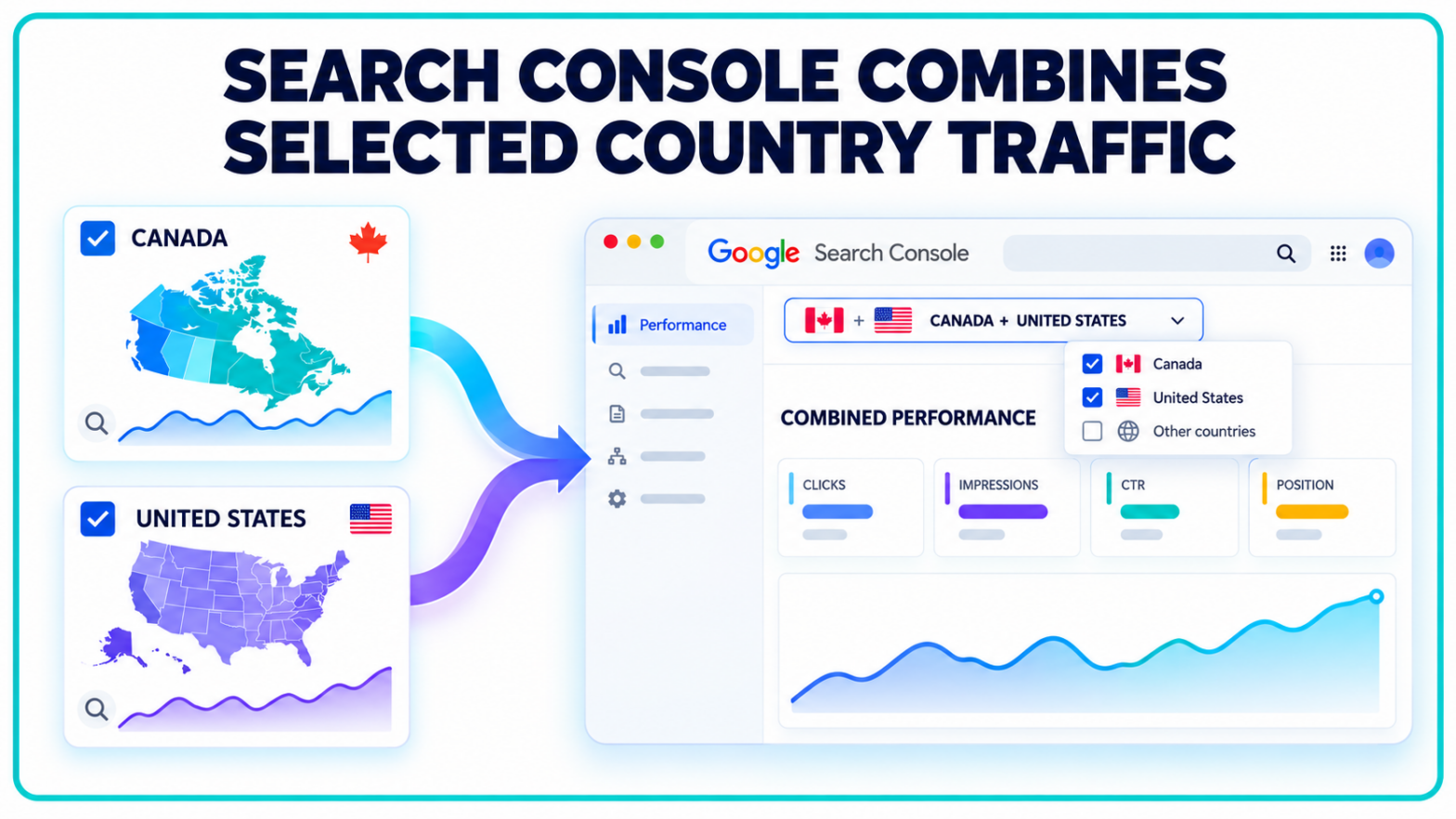
A business operating in Canada and the United States can now examine those markets together in Search Console. Google’s updated country filter combines selected countries into one view of search traffic.
The change addresses a reporting task that previously required separate country views or aggregation outside the interface. It gives teams a regional total without requiring them to include every country where their website appears.
Google Search Console Adds a Selected Market Total
Google Search Central announced the update on October 6 through its official LinkedIn account. The company said businesses operating in several countries can now view their combined Google Search traffic.
The country filter uses multiple selections, allowing a user to choose the markets that belong in the report. Canada and the United States, for example, can be included together while traffic from other countries stays outside that view.
The announcement also refers to analyzing traffic patterns across countries and devices. Its explicit country capability is the combined view; it does not establish that users can generate an unlimited set of separate country comparison charts.
For teams managing Google Search Console, that changes the population being analyzed. It does not change the website’s geographic targeting or the countries where Google can show its pages.
A reporting filter selects observations already collected.
Combining Countries Answers a Different Question From Comparing Them
A combined report measures a selected group’s performance. A comparison asks how one selection differs from another.
Those questions can produce very different readings of the same activity. A regional total may be stable even when traffic is rising in one country and falling in another. Combining them establishes the overall result, but does not explain each market’s contribution.
Consider a hypothetical site receiving 1,000 clicks from Canada and 3,000 from the United States in one period. The combined total is 4,000. If Canadian clicks later rise to 1,500 while US clicks fall to 2,500, the regional total remains unchanged.
Neither country remained unchanged.
Google’s filtering and comparison documentation continues to describe a separate comparison workflow. It documents one active comparison at a time, with a new comparison replacing an existing one.
The help page also retains wording that describes countries as a two-item comparison. Google’s newer announcement confirms multi-country filtering, so that older restriction should not be used to deny the announced combined view. It still does not establish unlimited multi-country side-by-side comparisons.
The useful distinction is between selecting a regional audience and diagnosing the differences within it.
Search Performance Rates Need the Combined Denominator
The standard Search results report offers clicks, impressions, click-through rate and average position, according to Google’s Performance report overview.
Clicks count interactions with site links in search results. Impressions measure appearances, while CTR divides clicks by impressions. Average position describes the topmost result from the site across the observations being measured.
When countries are grouped, rates need to reflect the combined population. Averaging the countries’ percentages equally can give a misleading answer if their impression volumes differ.
In a hypothetical example, Canada records 100 clicks from 1,000 impressions, producing a 10% CTR. The United States records 90 clicks from 9,000 impressions, producing a 1% CTR.
Together, the countries have 190 clicks from 10,000 impressions. Combined CTR is 1.9%, rather than the 5.5% obtained by averaging the two country rates.
The same reporting discipline applies when interpreting search performance: an average describes the underlying observations, rather than a single universal ranking for the website.
A change in the mix of searches can affect a regional average even when individual countries follow different trends.
A Country Filter Locates the Search Rather Than the Customer
Google’s dimensions guidance defines the country dimension by where the search originated.
That is narrower than a customer’s residence, a delivery destination or the market responsible for a sale. Search Console reports search activity; it does not turn a country selection into a customer or revenue segment.
The report can also be grouped by pages, queries and devices. Device categories identify desktop, mobile and tablet searches. These dimensions offer ways to investigate a regional change after establishing the combined total.
Query detail has limits. Google omits anonymized searches from query tables for privacy and retains only the most important data rows. A selected-country report does not remove those restrictions.
For marketers, the practical use is a repeatable regional view with the same countries, dates, search type and other filters across reporting periods. Country-level checks can then explain the combined trend, while website analytics supplies the separate evidence about on-site actions and conversions.
Consistent scope is part of SEO reporting. Changing the selected markets between periods changes the audience being measured, even when the report title remains the same.
Page Totals Still Follow Search Console Counting Rules
The convenience of a combined country selection does not make every table total interchangeable with the chart.
Google’s data aggregation documentation distinguishes property-level counting from page-level counting. When several results from one property appear for a search, the property can receive one impression, while a page grouping counts the individual URLs separately.
A sum of page rows can therefore differ from the property-level total. That is a consequence of aggregation, rather than evidence that the country filter failed.
The newest performance data may also be preliminary. Google marks it with a dotted line and notes that it can change as collection continues. Comparing complete periods avoids treating unfinished observations as final figures.
The October 6 announcement confirms that selected countries can now be viewed together. The resulting report remains a view of Google Search activity from those locations, with the existing metric definitions and counting rules attached.