
Google is sending a larger share of desktop searches to external websites, even as AI-powered search continues to expand.
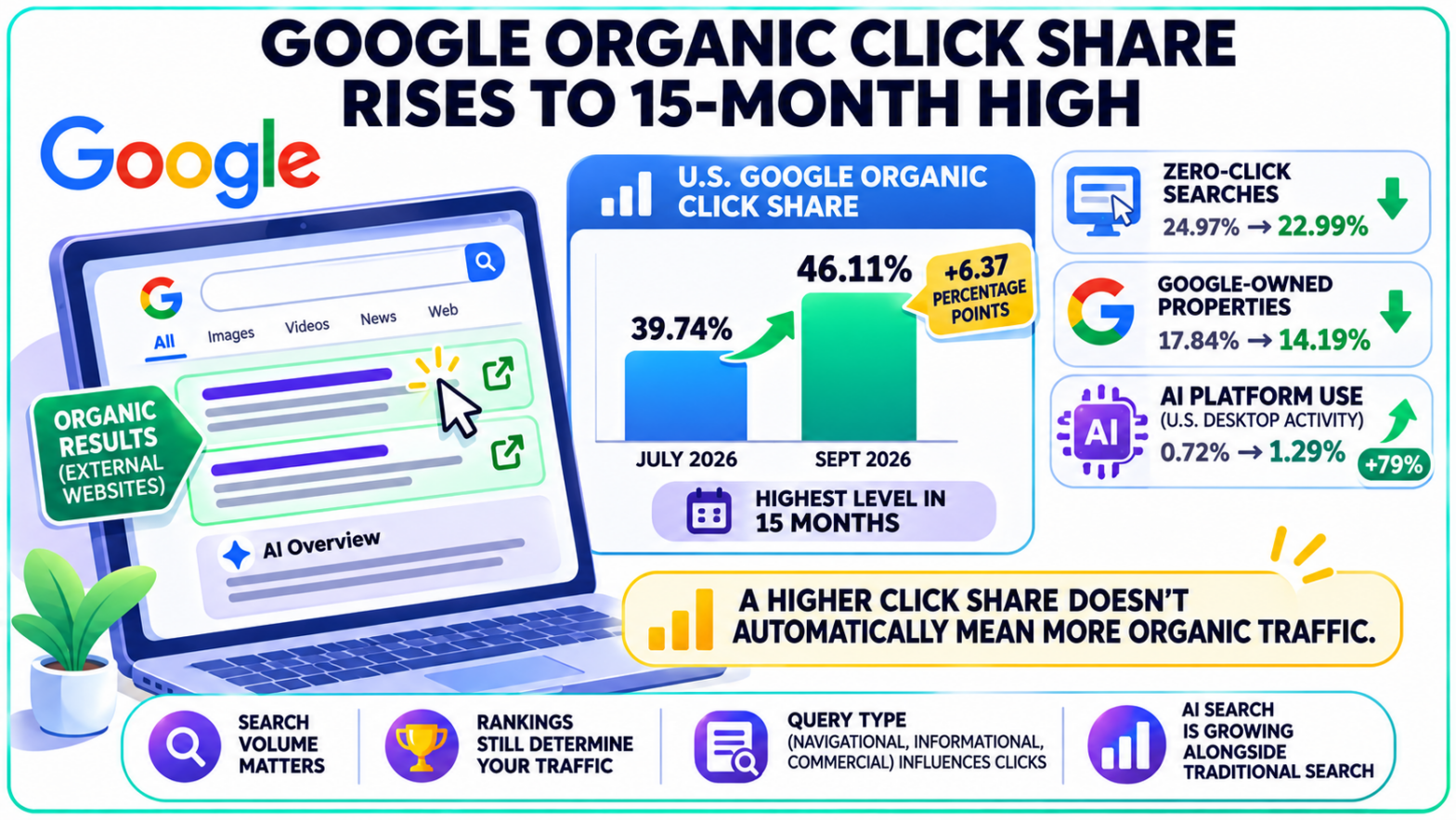
New data from Semrush shows that 46.11% of U.S. Google desktop searches resulted in organic clicks to external websites in September 2026, the highest proportion recorded during a 15-month study.
It's an unexpected development in a year dominated by concerns about declining organic traffic, AI-generated answers and searches that never leave Google.
But the finding comes with an important distinction. A growing share of clicks doesn't necessarily mean websites are receiving more visitors.
Google Organic Click Share Climbs 6.37 Percentage Points
The improvement becomes clearer when compared with earlier figures.
According to Semrush's State of Search Q3 2026 report, the share of U.S. Google desktop searches leading to organic clicks on external websites increased from 39.74% in July to 46.11% in September.
That's a gain of 6.37 percentage points in two months.
The September figure was the highest recorded between July 2025 and September 2026, the period covered by the study.
Other indicators moved in the same direction.
The proportion of U.S. searches ending without a click declined from 24.97% in July to 22.99% in September, reaching its lowest level since March.
Clicks directed toward Google-owned properties also declined, falling from 17.84% in August to 14.19% in September.
Together, those changes indicate that a greater proportion of the search activity measured by Semrush ended with users visiting websites outside Google's ecosystem.
European results showed a similar pattern.
Across 32 European countries, including the United Kingdom, organic click share reached 49.56% in September, while the share of zero-click searches declined to 20.99%.
The figures suggest that traditional search results continue to attract substantial engagement despite the increasing presence of AI-generated answers.
They don't establish what caused the improvement.
Changes in query behaviour, search result composition or the types of searches represented in the dataset could influence the distribution of clicks.
Semrush's findings identify a shift in observed behaviour, not a confirmed change to Google's ranking systems or a direct effect of its AI features.
A Higher Click Share Doesn't Guarantee More Organic Traffic
The distinction between click share and traffic volume is central to interpreting the report.
Organic click share measures the proportion of searches that produce an organic click. It doesn't directly measure the total number of visits received by individual websites.
Consider a simplified example.
If Google processes 100 million searches and 40% generate an organic click, that represents 40 million click-producing searches.
If the number of searches subsequently falls to 80 million while organic click share rises to 46%, the result is 36.8 million click-producing searches.
The percentage has improved, but the absolute number is lower.
The example is illustrative, not an estimate of Google's actual search volumes.
It demonstrates why a higher share cannot independently establish a recovery in organic search traffic.
The same limitation applies to individual websites.
A publisher could lose traffic despite an improving market-wide click share if its rankings decline, search demand weakens or competing websites capture a larger portion of available clicks.
The distribution of search activity also matters.
A larger proportion of navigational searches, where users are looking for a particular website, could produce more external clicks than a period dominated by informational questions.
Semrush's aggregate figures don't establish whether that change occurred or which categories benefited most.
TechWyse previously examined rising zero-click searches in a separate 2026 study, which found that 68.01% of U.S. Google searches ended without a click during the first four months of the year.
That figure cannot be compared directly with Semrush's September zero-click rate.
The studies use different datasets, methodologies and measurement periods. Their percentages shouldn't be treated as interchangeable estimates.
The latest findings offer a more encouraging picture of external clicking within Semrush's desktop sample, but they don't invalidate earlier research documenting traffic losses.
AI Search Is Growing Without Replacing Conventional Search
The increase in organic click share occurred alongside continued growth in AI tools.
Semrush found that AI platforms accounted for 1.29% of tracked U.S. desktop activity in September 2026, compared with 0.72% a year earlier.
That's an increase of approximately 79%.
Traditional search engines represented 9.47% of U.S. desktop activity, down from 10.29% in September 2025.
Those figures measure shares of broader desktop activity, rather than the percentage of Google searches generating clicks.
Google remained the dominant conventional search engine, accounting for 92.43% of traditional desktop searches in the United States.
European behaviour followed a somewhat different trajectory.
AI tools increased their share of desktop activity from 0.86% to 1.42% year over year, while traditional search also increased from 9.68% to 9.95%.
Google's share of traditional desktop searches reached 94.47% in Europe.
The data doesn't support a simple conclusion that AI adoption is replacing conventional search at the same rate across markets.
Google AI Mode continued gaining usage during the quarter.
In the United States, its share of desktop activity more than doubled from 0.15% in July to 0.31% in September.
European AI Mode activity reached 0.53% in August before declining to 0.43% in September.
Those numbers remain relatively small within the broader desktop activity dataset.
Yet AI search can still have a pronounced effect on the queries where it appears.
TechWyse previously reported on experimental evidence that Google AI Mode reduces publisher click-through rates.
That research examined how users behaved when exposed to different search experiences, rather than measuring aggregate activity across the market.
Both findings can be valid.
AI interfaces may reduce external clicks for particular searches while conventional Google results generate a greater share of clicks across the wider desktop search population.
The outcomes depend on what is being measured.
Longer Google Queries Reveal Another Shift in Search Behaviour
One of the more revealing findings concerns the length of searches.
In September, queries containing more than 15 words represented 2.58% of U.S. Google desktop searches, compared with 1.67% in August.
In Europe, the proportion reached 1.32%, up from 0.33% a year earlier.
These longer queries represent a relatively small part of search activity, but their growth suggests that some users are adopting more conversational ways of searching.
Instead of entering a few keywords, users may describe a problem, provide additional context or ask a more detailed question.
Such behaviour is commonly associated with generative AI assistants, although longer queries alone don't establish that users are consciously treating Google as one.
The development creates a more complicated picture of AI search adoption.
People aren't necessarily abandoning Google to ask complex questions elsewhere. Some are using Google itself for increasingly detailed requests.
That distinction matters for interpreting the relationship between AI systems and traditional search.
Google can accommodate longer, conversational queries while continuing to display conventional results that generate external clicks.
The Semrush data doesn't show which of those longer searches produced organic visits, nor does it establish how often AI-generated answers appeared alongside them.
It does show that search behaviour is changing while Google's conventional search activity remains substantial.
SEO Performance Still Depends on the Clicks Individual Websites Receive
Market-wide click share can describe changes in search behaviour. It cannot tell a business whether its own search performance has improved.
That requires a different set of measurements.
Google's Search Console Performance report separates clicks, impressions, click-through rate and average position.
Each metric answers a different question.
A website can receive more impressions without receiving more clicks. Its click-through rate can improve while impressions decline. Better average rankings don't always translate into more visitors.
Google also distinguishes Search Console clicks from Google Analytics sessions because the two systems measure different events.
For marketers, the practical implication is to evaluate organic click trends alongside absolute clicks, impressions, landing-page performance, search demand and recorded conversions. Comparing equivalent periods and separating mobile from desktop performance provides a more reliable view than applying an industry-wide click-share increase to an individual website.
Recent reporting anomalies add another reason to examine the underlying data.
TechWyse covered unusual Google Search Console click increases observed in early November 2026, where the source of the spikes remained unconfirmed.
Such anomalies don't explain Semrush's September findings, but they demonstrate why reported clicks and changes in actual business performance need separate scrutiny.
The new study has other boundaries.
Its observation period ends in September 2026, so it doesn't establish whether the increase continued into October or November.
It also excludes mobile activity.
For businesses whose audiences primarily search on smartphones, desktop click distribution may provide limited insight into actual acquisition performance.
Nor does the report establish whether particular industries, website categories or types of queries recovered more strongly than others.
Semrush's findings arrive as Google continues investing in AI Mode and related search experiences, leaving several parts of the user journey in transition.
The September result establishes one measurable development: within the study's U.S. desktop sample, external organic clicks captured their largest share in 15 months.
Whether that shift corresponds to sustained traffic growth for publishers and businesses remains a separate question that the report's aggregate figures cannot answer.