
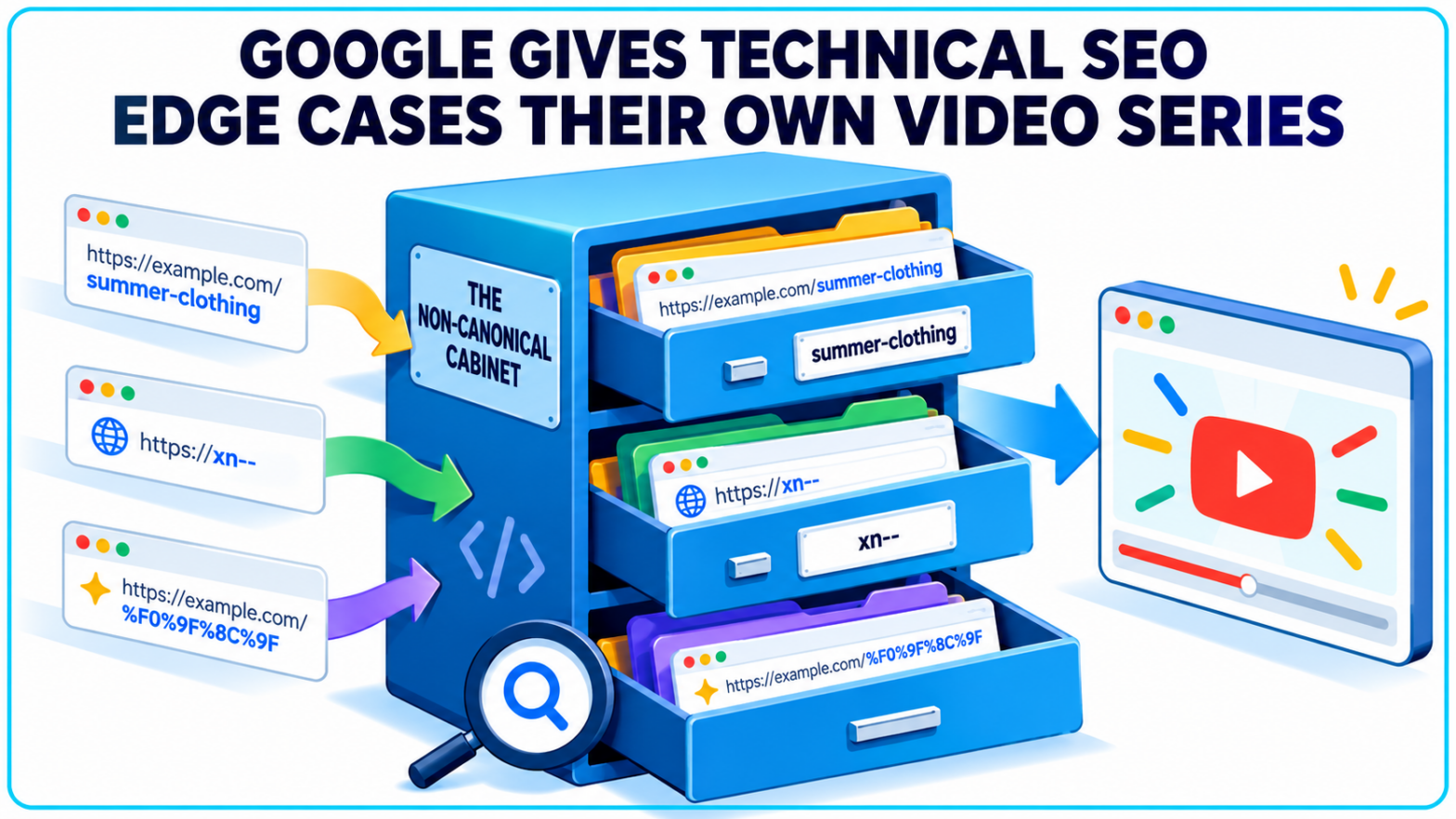
Some search questions are too specific for a help page but too persistent to disappear. Google is giving those edge cases an official home with The Non-Canonical Cabinet, a new video series built around the stranger corners of Search.
Google Search Central Makes Room for Questions the Documentation Skips
The Non-Canonical Cabinet is a new DevByte series hosted by Google’s Gary Illyes and Cherry Prommawin. Google published a trailer on October 6, 2026, followed by the first full episode on October 14.
Rather than working through SEO fundamentals in sequence, the show begins with highly specific questions submitted by website owners and search professionals. Google is also inviting viewers to leave additional edge cases in the comments for possible inclusion in future episodes.
The format is intentionally lighter than a standard developer tutorial. Google’s official series announcement describes it as a low-budget sitcom, complete with a physical cabinet where unusual questions have supposedly accumulated.
The information still comes from Google’s Search Relations team. That gives the series a more practical role than its presentation suggests: it can turn answers scattered across conference sessions, social posts and old office-hours videos into clear, attributable explanations.
For technical SEO teams, that distinction matters. Conventional documentation is designed around repeatable implementation requirements. Real websites regularly produce narrower questions involving unusual characters, legacy platforms, international domains or conflicting crawler behaviour.
The First Episode Separates Domain Rules From URL Paths
The opening episode examines what can appear in a domain name and what can appear later in a URL path. Those parts of an address may look similar in a browser, but they operate under different technical rules.
Domain names are constrained by standards maintained through organizations including the Internet Engineering Task Force and ICANN. Internationalized Domain Names allow domains to use scripts beyond basic Latin characters, with browsers and the Domain Name System handling those names through Punycode.
That process produces the familiar xn-- prefix in the machine-readable version of an internationalized domain. The episode also addresses the security and usability problems created when visually similar characters from different writing systems are difficult to distinguish.
Emoji face stricter limitations in domain names under current internationalized-domain standards. URL paths are more flexible.
Google’s existing URL structure documentation includes non-ASCII characters and emoji in path examples. It recommends percent-encoding those characters when they appear in links, converting the visible symbol into a standardized sequence that crawlers and servers can process.
Googlebot can crawl and process an encoded path containing an emoji. Display remains less predictable. A browser, messaging service or social platform may show the original character, the encoded string or another representation, creating a user-experience problem even when crawling works correctly.
Keywords in URLs Remain a Very Weak Ranking Signal
The debut also revisits one of SEO’s longest-running arguments: whether placing target terms in a domain or URL can materially improve rankings.
Illyes characterizes keywords in URLs as an extremely small signal. Their limited value is most relevant when Google has almost no other information about a page, such as when a site is brand new and does not yet contain meaningful content.
Once Google can evaluate the page itself, the words in its address become far less consequential. Page content, links and the wider collection of ranking signals give the system much stronger evidence about relevance.
The explanation does not establish a new ranking policy. Google representatives have described URL keywords as a lightweight factor for years.
It does provide a fresh answer to a recurring implementation dispute. A descriptive URL can help users understand a page, support cleaner analytics and make a site easier to manage. Packing repeated keywords into the path does not create a comparable ranking advantage.
That distinction is especially important during redesigns and migrations. Changing established addresses to add more keywords can introduce redirects, broken links, tracking problems and temporary indexing disruption. TechWyse has previously covered how a revised URL structure must be handled as part of a wider migration plan rather than treated as a cosmetic SEO adjustment.
Hyphens Still Beat Underscores for Separating Words
Google also returns to the choice between hyphens and underscores in URL paths.
Its published guidance recommends hyphens because they make separate concepts easier for users and search engines to identify. Underscores have historically been used in programming to join concepts that belong together, such as a function name.
A path such as /summer-clothing/ therefore follows Google’s preferred convention, while /summer_clothing/ does not. The latter can still be crawled. It simply provides a less conventional separation signal.
The guidance is not a reason to rebuild an established site solely to replace underscores. Redirecting large numbers of functioning URLs can create more risk than the separator change resolves. The recommendation is most useful when teams are creating new templates, taxonomies or sections and can choose a convention before publication.
For marketers and SEOs in practice, the series does not create a new optimization requirement. Existing sites following Google’s documented guidance do not need changes because the first episode repeats established principles. Its immediate value is diagnostic: teams gain an official reference when a narrow technical question begins consuming more development time than its potential search impact justifies.
The Series Could Become a Record of Search’s Unusual Failure Cases
Google already publishes documentation, Search Console training, office-hours videos and the Search Off the Record podcast. The Non-Canonical Cabinet occupies a narrower space between formal requirements and one-off community answers.
That space has grown as websites become more technically varied. JavaScript frameworks, internationalization systems, content delivery networks, automated publishing platforms and AI-generated site components can produce cases that a general SEO guide cannot anticipate.
The series description also connects its answers to generative AI features. Google continues to state that those experiences depend on the same crawlability, indexing and Search eligibility foundations used elsewhere, rather than a separate set of technical requirements. TechWyse has covered that broader position in its reporting on Google Search Central guidance for AI visibility.
Google has not announced a fixed publication schedule or the total number of episodes planned. The next instalment is expected to examine robots.txt, another area where a small change in syntax or crawler targeting can produce consequences far beyond the line that caused it.