

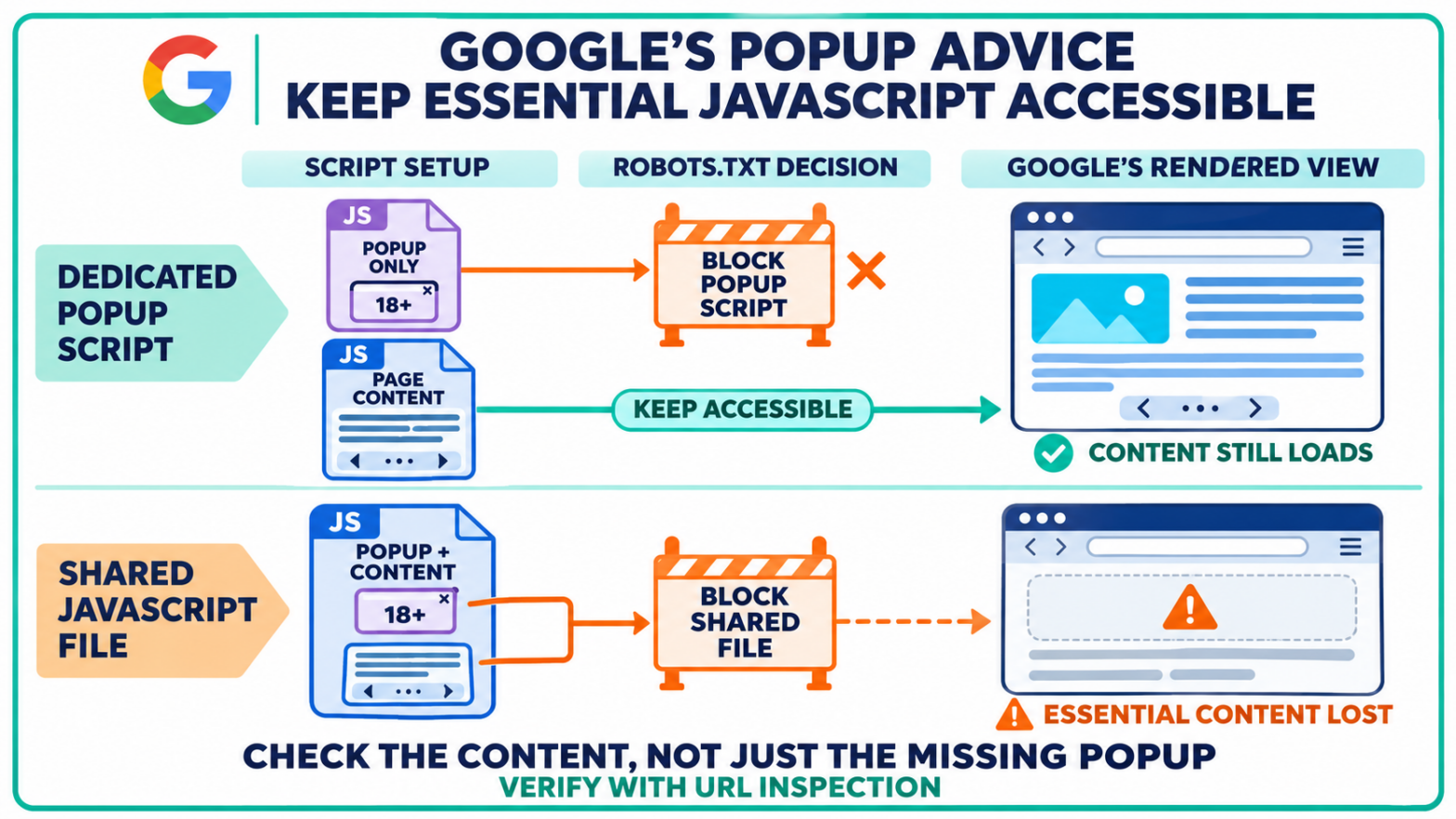
Blocking a popup script and blocking the code that builds a page are different SEO decisions. Google’s John Mueller has clarified that robots.txt can prevent an age-verification popup from loading during rendering, provided the underlying page still works.
The explanation came in a Reddit discussion about a hypothetical age-verification setup. The question concerned a popup supplied from another domain and whether blocking that resource would stop Googlebot from rendering it.
Mueller’s response supports a targeted approach. It does not establish a new permission to block JavaScript indiscriminately or suggest that Google no longer needs access to essential page resources.
A Shared JavaScript File Changes the Risk
Mueller distinguished a dedicated popup-loading script from a single JavaScript file performing several functions. He cautioned against blocking the latter.
That distinction matters because a crawl rule applies to the requested resource, not to an individual feature inside it. If one file loads both an age gate and essential page content, blocking the file can remove both from Google’s rendered view.
Google’s JavaScript processing documentation explains why. Search processes JavaScript-powered pages through crawling, rendering and indexing. Google does not render JavaScript from blocked files.
Some websites deliver their main content in the initial HTML response. Others initially supply an application shell and depend on JavaScript to populate it. The same blocking decision can therefore have very different consequences across two websites.
For JavaScript SEO, the relevant distinction is the script’s function, not its file extension. A resource used only for an overlay is different from one needed to display product information, article text or navigation.
A popup disappearing from Google’s screenshot is not sufficient evidence that the change worked correctly. The content underneath it must remain available.
Robots.txt Rules Follow the Resource’s Host
The discussion also exposed a common misunderstanding about third-party resources.
Google’s robots.txt specification says rules apply only to the host, protocol and port where the file is located. A website cannot use its own robots.txt file to issue crawl instructions for URLs hosted on an unrelated domain.
Mueller described two configurations. The external provider can block the embedded resource through its own robots.txt file. Alternatively, a website can block a dedicated script hosted on its own site that loads the external popup.
In either case, preventing Googlebot from fetching a required resource can prevent that resource from contributing to the rendered page.
The governing condition remains whether the page functions without it. Mueller wrote:
“You need to make sure that your pages still load when those URLs are not fetched, but for something like this, that's usually not a problem.”
Google’s introduction to robots.txt already permits blocking unimportant scripts, images and styles when their absence does not significantly affect the page. It warns against blocking resources that make the content harder to understand.
That is a crawl-management decision, not a universal indexing control. As TechWyse’s coverage of robots.txt explains, preventing a fetch and removing a page from search results are separate outcomes.
Mandatory Age Gates Already Have Separate Guidance
The age-verification example also sits within Google’s established guidance for mandatory interstitials.
Google’s documentation on interstitials and dialogues distinguishes legally required overlays from promotional interruptions. Mandatory interstitials are exempt from the guidelines discussed in that document, although Google still recommends implementations that preserve access to the underlying content.
For content behind a mandatory adult age gate, Google recommends allowing verified Googlebot requests to crawl without triggering the gate.
The documentation also warns against redirecting every incoming URL to a single consent or verification page. If Googlebot can fetch only that destination, the separate content URLs can disappear from search results.
Mueller’s reply therefore addresses an implementation question within an existing framework. It is not evidence that Google has relaxed its rendering requirements generally.
Nor does the age-gate example establish that any promotional overlay should be hidden from Google. Newsletter prompts, app-install messages and other interruptions remain subject to Google’s separate recommendations for unobtrusive presentation.
The distinction is between maintaining access to content and using a broad crawl restriction that accidentally removes it.
Rendered Content Provides the Relevant Evidence
A robots.txt edit changes which resources Google can retrieve. Its effect on a page becomes clear only when the resulting render is examined.
Google’s JavaScript troubleshooting guidance identifies URL Inspection and the Rich Results Test as tools for examining how a page is crawled and rendered. The available diagnostic information includes rendered content, loaded resources, JavaScript output and exceptions.
That makes Google Search Console useful for checking the individual page rather than relying only on aggregate indexing reports.
For marketers and SEOs, the practical implication is a focused review with the development team: identify the resource responsible for the overlay, establish whether other page functions depend on it, and compare the rendered content before and after any restriction. The relevant evidence is whether essential information remains accessible, not simply whether the popup disappears.
Google also documents that its Web Rendering Service may skip requests that do not contribute to essential page content, including some reporting and error requests. Client-side analytics consequently may not provide a complete or accurate record of Googlebot’s rendering activity.