

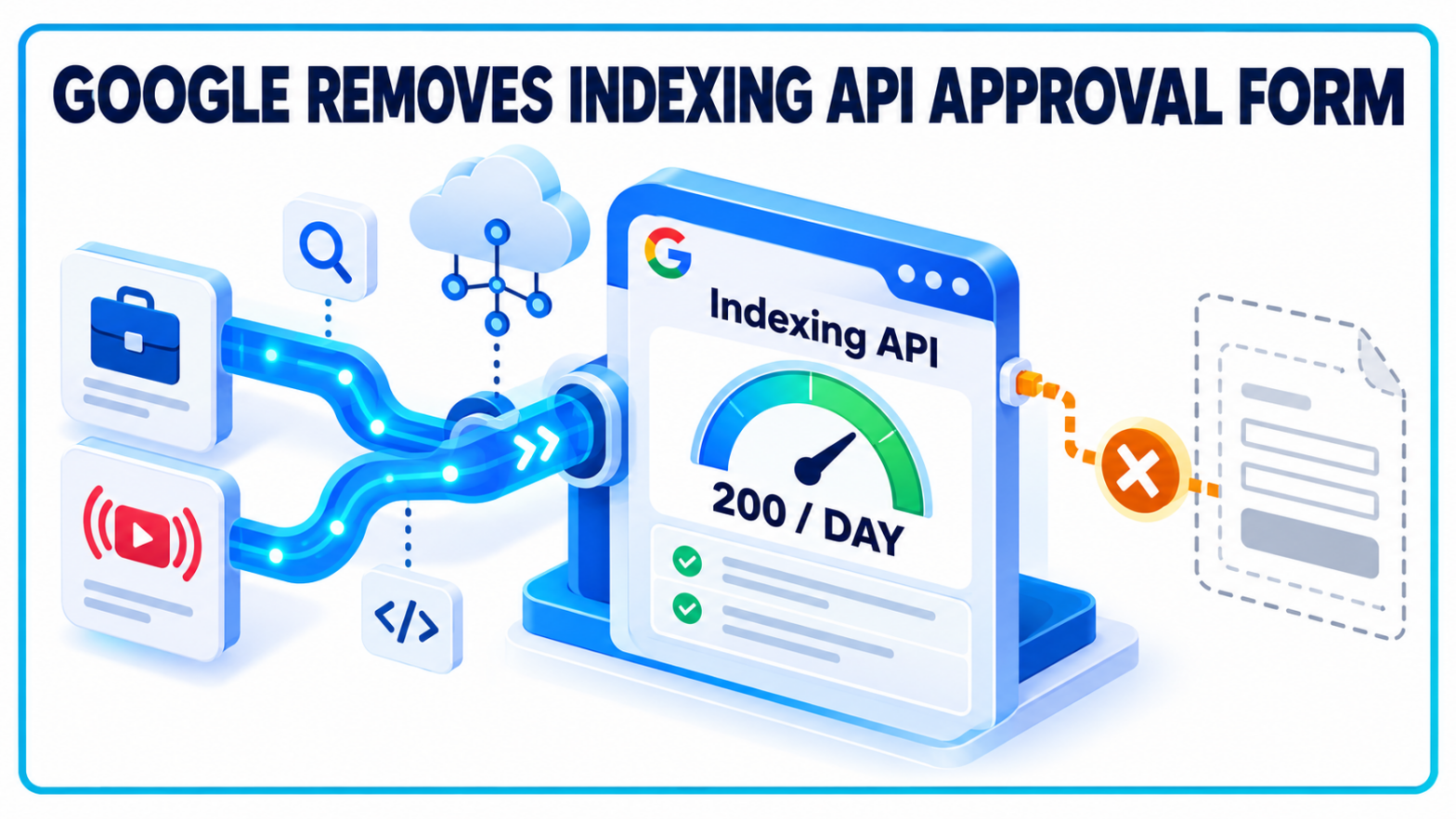
Google has erased the documented route for getting its Indexing API approved for production use or securing more quota. The tool remains available and its default limits are still published, leaving job boards and livestream publishers with working numbers but no public instructions for moving beyond them.
Google Removed the Route, Not the Indexing API Quota
Google recorded the change in its Search Central documentation log on October 16, 2026. The company said it had updated the Indexing API quota page to reflect current limits and processes, while removing an outdated form.
The edit was broader than deleting a link.
The previous documentation described the default quota as an initial allowance for onboarding and test submissions. It also said additional approval was required for usage and resource provisioning. A dedicated section directed developers to a form for requesting approval and quota beyond the default level.
Those instructions are gone.
The live page now states only that the Google Indexing API provides a defined quota, followed by its three limits. It tells developers to view project-specific allowances in the Google API Console, but it does not explain how to request an increase or obtain approval.
Google also updated its Indexing API Quickstart on October 16. Its setup process now consists of completing the technical prerequisites, following the usage guidelines and sending requests. Requesting approval is no longer listed as a separate step.
That does not confirm that Google has abolished approval requirements. The changelog says the removed form was outdated, but it does not identify a replacement process or state that approval is no longer necessary.
The 200-Request Daily Limit Still Applies
The documentation may be shorter, but the published numbers have not disappeared.
Google currently lists a default allowance of 200 publish requests per project each day. Both URL_UPDATED and URL_DELETED notifications count against that total. The daily allowance resets at midnight Pacific Time, and Google notes that a new quota can take up to 24 hours to become effective.
Two per-minute limits also remain:
- 180 read-only metadata requests per project
- 380 total requests across all endpoints per project
Use of the API remains free.
Batching does not provide a way around those limits. Google permits developers to combine as many as 100 calls in one HTTP request, but its usage documentation says quota is calculated at the URL level. A batch containing 100 URL notifications therefore consumes 100 requests.
That distinction matters for large platforms. A small employer publishing a few openings may rarely approach the daily ceiling. A recruitment marketplace processing hundreds or thousands of new, revised and expired listings can exhaust it quickly, particularly because updates and removals draw from the same allowance.
The uncertainty is procedural, not numerical. Google publishes the default limits clearly. What it no longer publishes is the route for a qualifying project that needs more capacity.
Eligibility Remains Narrow for Jobs and Livestreams
The documentation edit has not turned the Indexing API into a general-purpose indexing tool.
Google’s current guidance still limits its use to pages containing JobPosting markup or BroadcastEvent markup embedded within a VideoObject. Blog posts, product pages, service pages and other ordinary URLs are not eligible simply because a site owner wants them crawled sooner.
That boundary is especially important as third-party indexing services continue to market rapid submission as a broader technical SEO tactic. Removing an approval form does not expand the content types Google says the API supports.
The implementation rules remain strict as well. Every request must be authenticated, and the submitting service account must have the necessary ownership permissions. Google subjects submissions to spam detection and warns that attempts to bypass quota limits, including through multiple accounts, may result in access being revoked.
Eligible pages must also satisfy the underlying content policies. Job listings require valid job posting structured data, visible job information and a genuine way to apply. Expired listings must be removed, marked with a past validThrough date or stripped of their JobPosting markup.
For livestream pages, the relevant BroadcastEvent data must be nested within a VideoObject. Google has continued to refine its wider structured data requirements, but the October quota edit did not announce any new eligible page category.
A Successful API Call Still Does Not Guarantee Indexing
An HTTP 200 response confirms that Google accepted the notification. It does not confirm that the submitted URL has been indexed or removed.
Google says a successful update notification means its systems may attempt to recrawl the page soon. For deletion requests, it means Google may remove the URL. The metadata endpoint is similarly limited: it reports when Google last received an update or deletion notification, not when the corresponding indexing action occurred.
That separation creates a reporting risk. Developers can record successful API requests while the affected pages remain absent from Search, retain old content or wait for another crawl. Submission, crawling and indexing are connected stages, but they are not interchangeable.
Google’s job posting documentation still recommends the Indexing API over sitemaps for individual job URLs because API notifications can prompt Googlebot to crawl them sooner. It also continues to recommend a sitemap for full-site coverage, with accurate lastmod values identifying recently changed pages.
Notably, the general Quickstart no longer includes its former comparison between the API and sitemaps. The more specific job posting guide still does. Publishers therefore retain official support for using both systems together, even though the introductory documentation has become less explicit.
High-Volume Publishers Now Have an Operational Blind Spot
The practical impact falls most heavily on job boards, recruitment platforms and livestream publishers whose daily activity exceeds the default allowance.
Teams operating those sites can still inspect their current limits in Google Cloud Console and monitor API responses, submission volumes and failed requests. They can also preserve sitemaps, accurate modification dates, crawlable internal links and Search Console monitoring as separate parts of their Google Search indexing workflow.
What they cannot find in the revised Search Central documentation is a public approval process for moving beyond the default quota. Google has not clarified whether previously submitted applications remain under review, whether another request channel will replace the removed form or how higher-volume projects should now seek additional capacity.
As of October 19, the quota page still directs developers only to view their limits in the Google API Console. Its published ceiling remains 200 update and deletion notifications per project per day.