

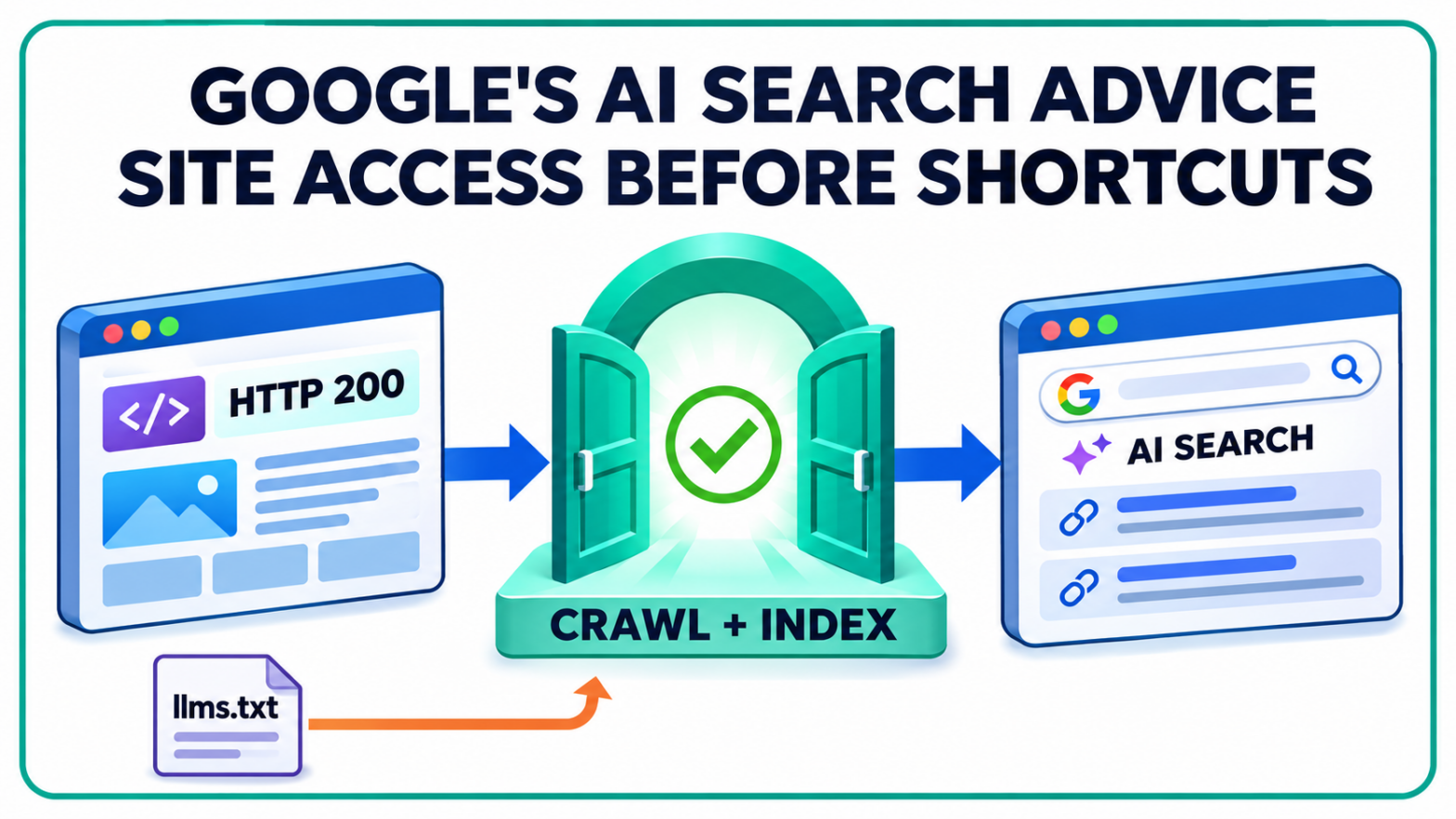
AI-specific optimization cannot replace the work that makes a website accessible to search engines. Google’s John Mueller has reiterated that technical SEO remains relevant as AI systems build on existing search infrastructure.
In a video interview with David Iwanow, Mueller discussed the continued role of SEO and the risks of relying on short-lived tactics. His comments reinforce Google’s published guidance rather than introduce a new ranking update.
For businesses deciding where to spend their search budgets, the distinction is consequential. Improving access to useful content addresses a documented requirement. Producing a separate version of a website for AI systems does not automatically create a visibility advantage.
AI Eligibility Starts With an Indexed Page
Google’s AI-generated answers still depend on content that its search systems can discover and process.
The company’s guidance on AI features and website eligibility says a page must be indexed and eligible to appear in Google Search with a snippet before it can qualify as a supporting link in AI Overviews or AI Mode.
That requirement comes before questions about how an answer is written or which sources it cites.
Google’s technical requirements for Search establish the underlying conditions: Googlebot must be able to access the page, the server must return a successful HTTP 200 response, and the page must contain indexable content.
A page behind a login, an inaccessible resource or an error response presents a different problem from a page that simply has not been selected for an AI answer.
Even meeting the requirements does not guarantee indexing. Google explicitly separates technical eligibility from whether its systems ultimately crawl, index or display a page.
JavaScript Still Needs to Expose the Content
A website can look complete to a visitor while requiring additional processing before Google can access its main information.
Google’s JavaScript SEO documentation explains that some sites initially deliver an application shell without the actual page content. Google then needs to execute JavaScript to render that content.
Google can perform that rendering. The issue is whether the resources it needs are accessible and whether the resulting page exposes the information intended for indexing.
The documentation also recommends considering server-side rendering or pre-rendering, noting that not every bot can execute JavaScript. Google’s capabilities should not be treated as evidence that every AI crawler behaves identically.
For marketers and SEOs, the practical implication is to distinguish an access problem from a selection problem. Inspecting a priority page’s response, indexing status, and rendered content can establish whether its information is available before a team attributes weak AI visibility to wording or formatting.
That remains recognizable technical SEO work, even when the intended destination is an AI-generated answer.
Special Files Do Not Replace SEO
Google’s position on AI SEO leaves little room for treating an extra file as a shortcut around those requirements.
Its generative AI optimization guide says Google Search does not require llms.txt files, special AI text files, Markdown versions or additional markup. It also says llms.txt neither helps nor harms Search visibility because Google Search ignores it.
The scope matters. A format may have a use in another service or an agent workflow without becoming a Google ranking signal.
Google also rejects the idea that publishers must divide their content into tiny sections for AI systems. It specifies no ideal page length and no special schema.org markup required for generative search.
Content quality remains a separate consideration. In its guidance for succeeding in AI search experiences, Google emphasizes original, useful information and pages that visitors can navigate comfortably. Technical access allows content to be considered; it does not establish that the content offers something worth selecting.
Publisher Controls Can Exclude an Eligible Site
Crawling and indexing are not the only settings affecting participation.
Google’s Search generative AI control, available worldwide since August 31, 2026, lets site owners manage whether their links and content appear in AI Overviews, AI Mode and generative AI features in Discover.
Inclusion is the default at the top level. Child properties can inherit a parent property’s setting or have their own configuration.
An otherwise accessible site can therefore be excluded from the covered AI experiences through a publisher choice, rather than a technical fault or a content-quality decision.
Google says exclusion prevents the site’s content from appearing in those features or helping ground their responses. The control does not act as a ranking or inclusion signal for other parts of Search.
It is also separate from AI training controls. A decision about participation in Search’s generated answers should not be confused with a decision about model training.
Search Console Measures AI Exposure Separately
The distinction between eligibility and selection also affects reporting.
Google Search Console now provides a dedicated generative AI performance report for Search. Google’s report documentation describes impression data for AI Overviews and AI Mode, with views by page, country, device and date.
Those figures help identify which pages are appearing. They do not, on their own, establish that a visitor reached the website or became a customer.
For businesses assessing AI search visibility, that separates three questions: whether a page can participate, whether Google displays it, and whether the resulting exposure supports business outcomes. A technical repair can address the first without guaranteeing the other two.
Google also says the dedicated report may not appear when a site has received too few impressions in its generative AI features. An absent report is therefore not, by itself, proof that Google cannot crawl or index the website.