

A low bidding target can keep YouTube advertising costs under control. It can also prevent a campaign from spending its budget.
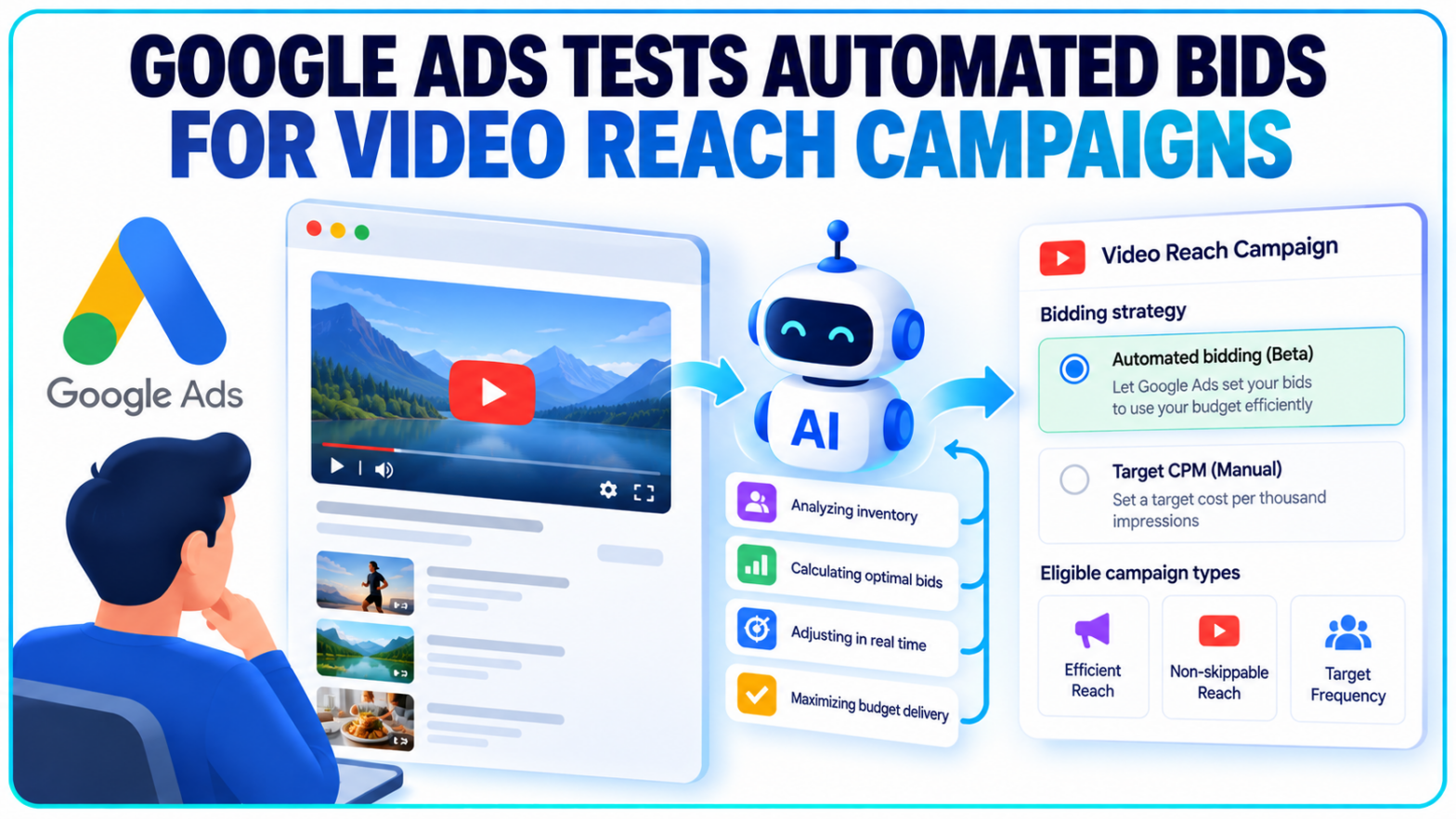
Google Ads is testing a way around that problem by letting its bidding system determine how much to bid for Video Reach campaigns, removing the need for advertisers to enter a Target CPM before launching. The feature is available in beta to eligible accounts, with manual bidding targets remaining an option.
The experiment gives Google more control over the price of reaching viewers. For advertisers, the trade-off is between delivering more of a planned budget and maintaining predictable costs per thousand impressions.
Google Ads Automated Bidding Removes the Required CPM Target
Video Reach campaigns are designed to build brand awareness by reaching audiences across Google's video advertising inventory.
Traditionally, advertisers have used Target CPM bidding to tell Google approximately how much they're willing to pay for every thousand impressions.
CPM, or cost per mille, measures the cost of serving 1,000 ad impressions. A lower target can help control advertising costs, but setting it too conservatively may limit participation in competitive auctions.
The campaign might reach fewer people than expected or finish with part of its budget unspent.
Google's new automated bidding beta for Video Reach campaigns approaches that problem differently.
Instead of requiring advertisers to select a Target CPM, Google Ads can now calculate bids automatically and adjust them during individual ad auctions.
The system is designed to use the available campaign budget efficiently without requiring advertisers to estimate a suitable bidding target.
Google identifies several intended benefits, including simpler campaign setup, reduced manual bid adjustments and improved budget delivery.
The change is particularly relevant to campaigns targeting unfamiliar audiences or launching without historical cost data.
Advertisers previously needed to establish an initial bidding target despite having limited information about competitive auction prices.
Under the experimental system, they can leave that decision to Google.
The feature does not remove campaign budgets, targeting settings or creative requirements. It changes how the bid price is determined after those parameters have been established.
Spending the Full Budget Takes Priority Over Holding a CPM
The most consequential difference between the two bidding methods concerns cost control.
With Target CPM bidding, advertisers specify a preferred average cost per thousand impressions. Google's system then optimizes delivery toward that target.
According to its documentation, the system seeks to generate as many impressions or views as possible while maintaining an average CPM at or below the advertiser's selected target.
Individual auction bids can still vary. Target CPM is an average cost objective, not a fixed price for every impression.
The new automated option removes that advertiser-defined cost target.
Google instead adjusts bids dynamically, aiming to deliver the campaign's full budget while maximizing available results.
That distinction becomes significant when competition increases.
An advertiser using a relatively low Target CPM may miss impressions because its bids are insufficient to compete in particular auctions.
Automated bidding gives Google greater flexibility to enter those auctions at prices determined by its bidding system.
Google's documentation describes full budget utilization as a primary objective of the feature.
However, greater budget delivery does not necessarily indicate greater cost efficiency.
A campaign could spend more of its allocated budget while reaching audiences at a higher average CPM. The eventual balance depends on targeting, available inventory and auction conditions.
Google specifically warns that combining high budgets with extremely narrow audience targeting can increase average CPMs because automated bidding prioritizes spending the allocated budget.
Advertisers operating under strict media-buying cost requirements may therefore prefer the existing Target CPM option.
The beta offers two different approaches to the same campaign objective: one prioritizes automatic budget delivery, while the other retains an advertiser-specified average cost target.
Three Video Reach Campaign Types Support the Beta
Google's official documentation identifies three eligible Video Reach campaign subtypes.
Efficient Reach campaigns are included. These campaigns use combinations of video formats to maximize the number of unique people reached within the available budget.
The beta also supports Non-skippable Reach campaigns, which use formats designed to deliver an advertiser's complete video message.
Target Frequency campaigns are eligible as well. These campaigns focus on reaching people a specified number of times during a defined period.
The three subtypes address different advertising objectives, but all can use Target CPM bidding.
Google lists YouTube, Google video partners and Google TV among the supported networks. Both daily budgets and campaign-total budgets are supported.
The distinction between Video Reach and Video View campaigns is important.
Google explicitly states that the new automated bidding option is not currently available for Video View campaigns.
Those campaigns focus on generating video views rather than maximizing audience reach.
Advertisers should also distinguish this experiment from other Google Ads bidding changes.
As TechWyse previously reported, Google's August 2026 Smart Bidding changes affected how certain budget-constrained campaigns optimize toward Target CPA and Target ROAS objectives.
Video Reach and Video View campaigns were excluded from that adjustment.
The new beta is a separate development focused specifically on bidding for Video Reach campaigns.
Google has not announced whether the automated bidding option will eventually expand to other video campaign categories.
Advertisers Can Change Bidding Methods After Launch
Google is not making the automated option an irreversible campaign setting.
Eligible advertisers can switch between automated bidding and Target CPM bidding during campaign creation or after a campaign has started running.
When creating a new eligible campaign, automated bidding appears as the default option.
Advertisers can configure their campaign name, budget, dates and targeting, then proceed to the ad group's bidding section.
Leaving the default setting unchanged allows Google to manage the bids automatically.
Advertisers who want to retain a Target CPM can select the option to enter a target and provide their preferred amount.
The same choice remains available after launch.
Google's documentation confirms that advertisers can change bidding methods through ad group settings or directly from the bidding columns in reporting tables.
Campaign duplication also supports both approaches.
When copying an existing campaign or ad group, advertisers can choose to retain existing bids, apply suggested bid guidance or clear the original bids and allow Google to manage them automatically.
Google is also changing how eligible campaigns are estimated during setup.
The company says its campaign construction panel can generate performance forecasts using budget, campaign dates and video creative without requiring advertisers to enter a bid.
That removes one input from the planning process, although forecasts remain estimates rather than commitments about actual delivery.
These changes reduce the manual work associated with establishing and maintaining bidding targets. They do not remove the need to define campaign objectives or evaluate the results.
Higher Budget Delivery Still Requires Closer Reach Measurement
The experiment adds another automation option to Google's expanding set of YouTube campaign management tools.
In July 2026, Google introduced video campaign groups that allow advertisers to coordinate reach and frequency objectives across multiple video campaigns.
Those tools operate at the campaign-group level, helping advertisers manage audience exposure across separate campaigns while retaining individual budgets and creative settings.
The automated bidding beta works at a different level by changing how bids are calculated during campaign delivery.
Both developments concern reach efficiency, but they address different parts of the buying process.
Google has also expanded reporting for video advertising.
As previously covered by TechWyse, YouTube brand campaign measurement now includes broader reporting capabilities such as Attributed Branded Searches, helping advertisers examine activity associated with exposure to video ads.
Those measurement developments provide additional context for evaluating campaigns where immediate conversions are not the primary objective.
For marketers testing automated bidding, the practical comparison is between budget delivery and the actual cost of audience exposure. Campaign spending, average CPM, impressions, unique reach and frequency should be reviewed together. A higher spend rate may resolve under-delivery, but it does not independently establish whether the campaign reached the intended audience efficiently.
Google recommends allowing approximately 24 hours for the automated system to adjust to auction conditions before making significant audience or budget changes.
That guidance is intended to give the bidding system an initial period to respond to available inventory and competition.
Campaign managers can then assess whether automated bidding provides a more suitable balance of reach, cost and budget utilization than their existing targets.
The feature remains limited to eligible Google Ads accounts.
Advertisers who cannot see the automated bidding option must continue setting and managing Target CPM bids through the existing workflow.
Google has not published a general availability date or confirmed when additional accounts will receive access.
For now, the beta introduces a new choice for eligible Video Reach advertisers: set the average cost target themselves or allow Google to determine bids in pursuit of fuller budget delivery.