

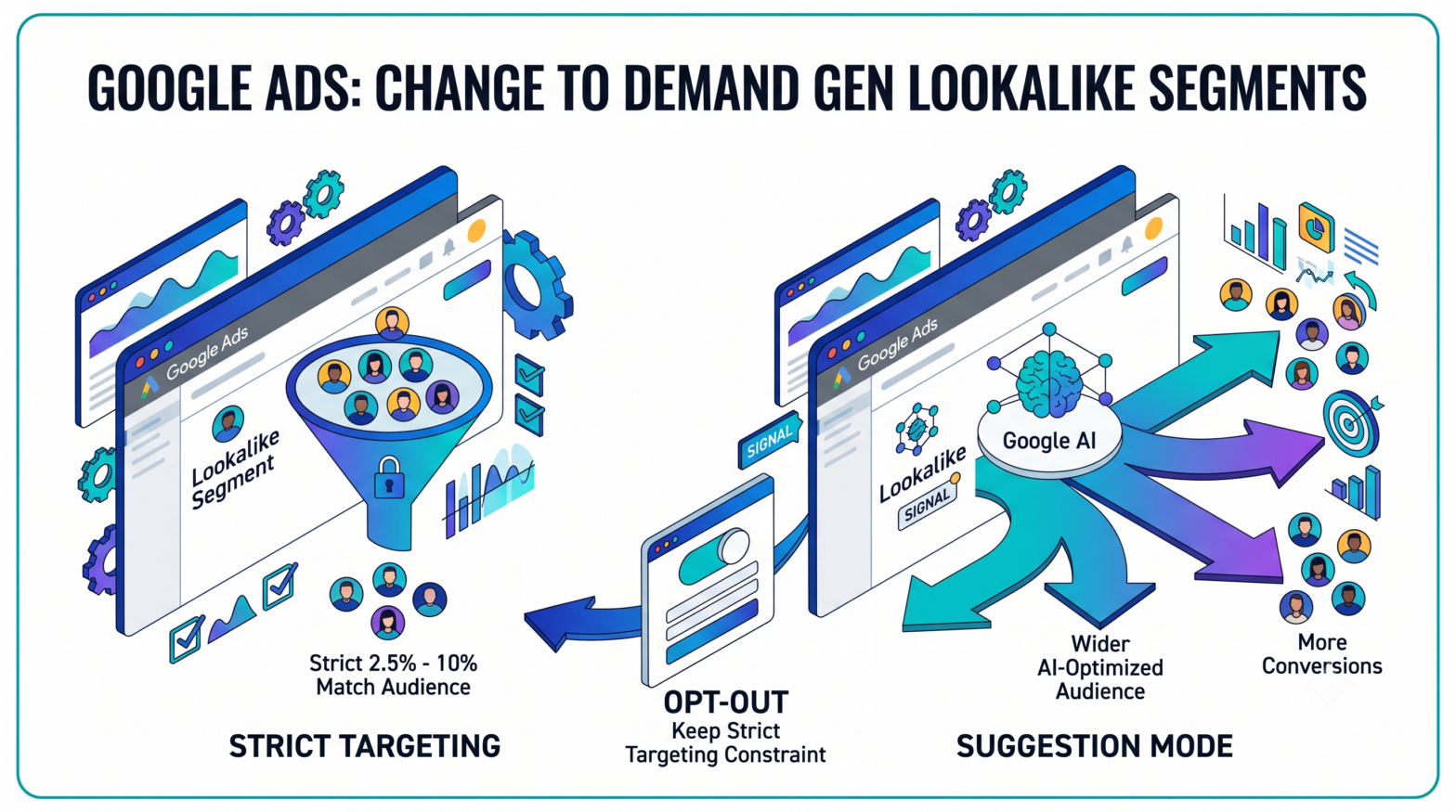
Demand Gen advertisers using Lookalike segments to restrict ad delivery to tightly defined audiences will see that behaviour change automatically unless they act. Google confirmed in its updated Ads Help documentation, titled "Use Lookalike segments in Demand Gen campaigns as a Targeting Constraint", that Lookalike segments will default to a suggestion mode unless the ad group has been opted out of the Lookalike-as-a-suggestion update.
What Is Changing in Demand Gen Targeting
Google Ads officially notified advertisers of a fundamental change to how Lookalike segments function within Demand Gen campaigns. Starting March 15, 2026, Lookalike segments transitioned from strict similarity thresholds to audience suggestions powered by Google's AI systems.
Google published updated Help Center documentation announcing the change on February 17, 2026, with the update effective March 2026. No action was required for the change to take effect. All Demand Gen campaigns using Lookalike segments automatically transitioned to signal-based targeting in March 2026 unless an opt-out request was submitted.
The scope of the change is limited to one campaign type. This change only affects Lookalike segments attached to Demand Gen campaigns in Google Ads. It does not affect Lookalike audiences used in Video brand campaigns, Display & Video 360, or other campaign types.
How Lookalike Segments Now Function
Under the previous model, advertisers selected a similarity tier, and campaigns delivered ads only to users within that defined pool. With the Lookalike-as-a-suggestion update, the reach slider that was narrow, balanced, and broad no longer functions as a targeting constraint. Instead of restricting an ad group's reach to specific similarity thresholds of 2.5%, 5%, or 10% of the target location, the system uses the selected reach level and seed list as signals to help Google AI prioritize conversions.
The seed audience and selected reach level become signals. Google can reach users outside those thresholds when it predicts stronger performance against the campaign goal, such as conversions or CPA.
A "signal" tag will appear next to Lookalike segments in the Audience Reporting table to indicate when the segment is operating in suggestion mode rather than as a hard constraint.
Seed List Requirements and Segment Mechanics
Lookalike segments are built entirely from first-party data. Lookalike segments, built from first-party seed lists such as Customer Match, website visitors, app users, or YouTube viewers, will now guide delivery rather than act as a targeting constraint.
In constraint mode, the existing seed list floor applies. The combined active matched people across all seed lists must exceed 100, and segments refresh every one to two days. Google also confirmed the previous 100-user minimum for creating a Demand Gen Lookalike no longer applies in suggestion mode.
Ad groups with both Lookalike-as-a-suggestion and Optimized Targeting enabled will find higher performance gains captured by Lookalike-as-a-suggestion mode. This means performance will shift from Optimized Targeting toward the Lookalike segment in the Campaign reporting table. However, Optimized Targeting might still capture performance gains by reaching users beyond Lookalike-as-a-suggestion's reach.
How Advertisers Can Preserve Strict Targeting
Google has acknowledged that some advertisers may not want to benefit from the Lookalike-as-a-suggestion update. Advertisers who prefer to keep Lookalike behaviour consistent with the previous version may opt out of the change by applying through a form linked in the Help documentation. Google states to expect removal within three days.
The opt-out is not a global toggle available within the standard Google Ads interface, at least not initially. Google has indicated that UI controls for managing this preference will become available later in 2026, but early adopters of the opt-out must go through the form submission process.
Practical Implications for Advertisers
Demand Gen advertisers who depend on tightly defined audience boundaries, for brand safety, audience fit, or compliance purposes, should verify which mode is currently active on each affected ad group and submit an opt-out request if constraint-based targeting is required. Advertisers who do not opt out and remain in suggestion mode should monitor conversion quality, customer acquisition costs, and customer lifetime value independently of volume metrics, since expanded reach does not automatically indicate equivalent conversion quality. Segment-level reporting remains available through the Audiences menu and the Campaigns reporting table, giving advertisers visibility into how each Lookalike segment is performing under either mode.
Google's updated Help page for Lookalike segments in Demand Gen states the default behaviour "will evolve towards a suggestion mode," and directs advertisers to opt out through a form linked on the page, though the page gives no specific date for the mode change and no opt-out deadline.