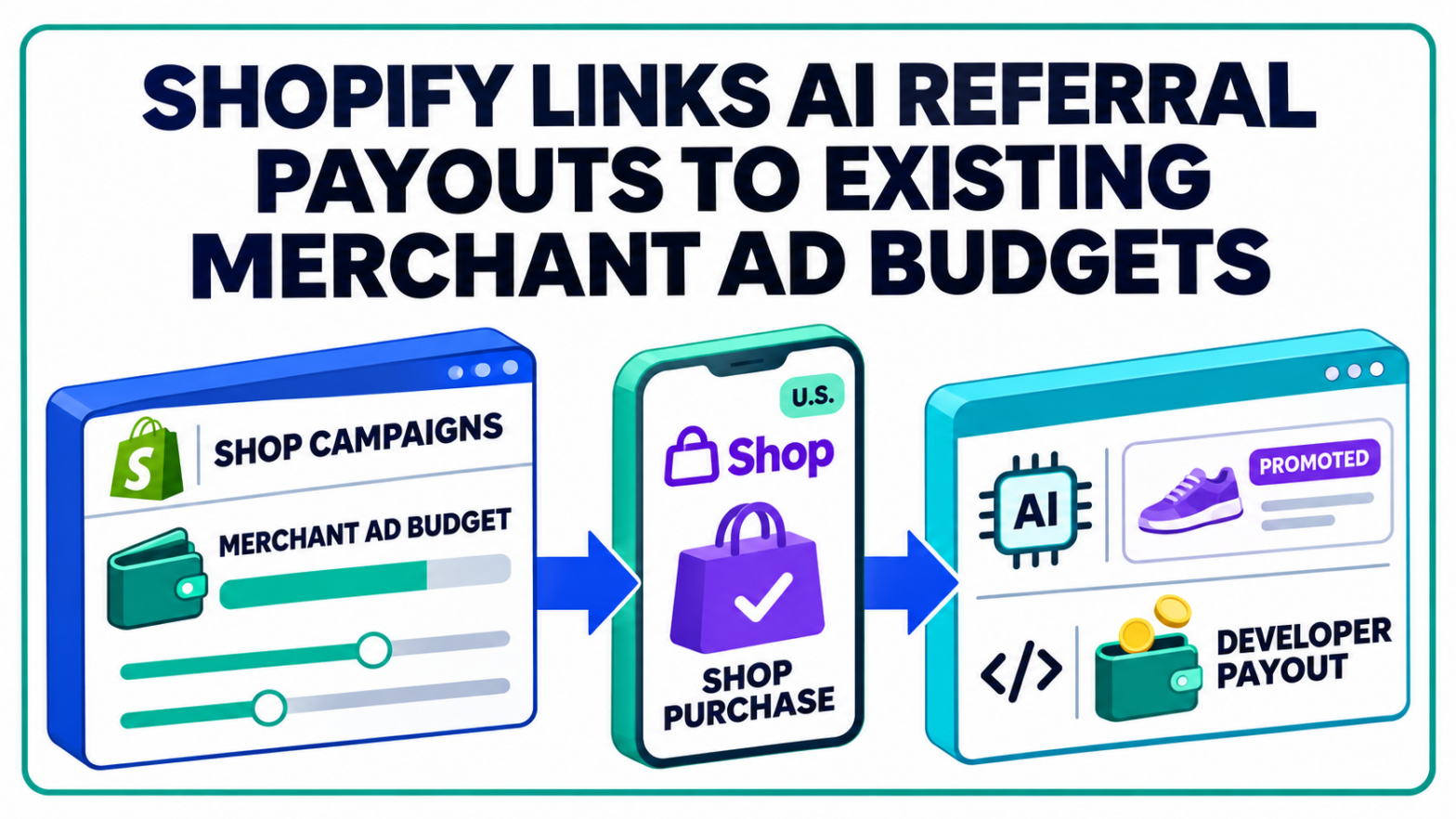
A Shopify advertising budget can now fund commissions for the developer behind an AI shopping experience. The connection runs through Shop Campaigns, rather than a separate payment agreement between each store and an AI assistant.
Shopify’s October 27 developer update adds merchant-funded commissions to its Promoted Placements beta. For participating developers, qualifying product referrals can earn a merchant-funded amount on top of Shopify’s base commission.
The commercial arrangement has several boundaries. Developer access remains invite-led, the higher payout depends on where the purchase happens, and a merchant’s advertising charge follows different rules from the developer’s earnings.
Shop Campaigns Becomes the Merchant Funding Route
Merchants already running Shop Campaigns with external platforms enabled now include Shopify’s Catalog API among those platforms.
Shopify converts the merchant’s campaign settings into an additional commission. Developers receive the combined rate with the product information returned by the catalogue, rather than negotiating a separate rate with each store.
The merchant-facing controls remain part of an existing acquisition programme.
Shopify describes Shop Campaigns as advertising charged when a customer converts, without an upfront budget payment or subscription fee. Merchants set an average customer acquisition cost.
Its campaign-management guidance also provides controls for daily budgets, target countries, target order value and optional customer-segment overrides. Advertising on third-party platforms is a separate channel choice.
TechWyse has previously covered how Shop Campaigns fits into Shopify’s broader marketing tools. The October update extends that acquisition infrastructure into eligible catalogue referrals.
AI Shopping Agents Need an Enrolled Catalogue
Making products discoverable to an agent is not the same as participating in paid placements.
Shopify’s catalogue documentation distinguishes between Global Catalog, which supports cross-merchant product discovery, and Storefront Catalog, which searches an individual merchant’s store. Both implement the Universal Commerce Protocol’s catalogue capability.
Promoted placements operate through Global Catalog. Approved developers can request results that blend promoted product variants with organic variants.
Participation requires enrolment and an enabled saved catalogue. The October changelog says developers must pass that catalogue’s identifier when requesting search results and preserve the product URLs Shopify returns.
For enrolled developers, newly created saved catalogues have earnings enabled by default. Existing saved catalogues require the setting to be switched on.
This paid distribution layer sits within the wider agentic commerce infrastructure connecting discovery with purchasing. It does not establish that every assistant using Shopify product data participates in the commission programme.
Nor does Shopify’s announcement establish that the highest commission guarantees the highest ranking.
Higher Commissions Depend on a Shop Purchase
Shopify’s promoted-placement documentation specifies a base commission of 0.3% on eligible attributed purchases.
The merchant-funded addition has narrower conditions. It applies to products in active U.S. campaigns, in U.S. dollars. Developers receive the higher rate only when the buyer completes the purchase in the Shop mobile app or on shop.com. Otherwise, an eligible purchase earns the base rate.
The October announcement says links for products carrying merchant-funded commission send shoppers to Shop.
Commission can cover every eligible Global Catalog item in the attributed order, rather than only the product originally clicked. Each eligible item earns its applicable rate.
For marketers, the practical distinction is between product discovery, the destination receiving the referral and the purchase credited to the campaign. Assessing this channel involves acquisition cost, order value and checkout location, not simply whether an agent displayed a product.
Paid Results Carry Disclosure and Attribution Obligations
Shopify requires developers to distinguish promoted results from organic ones and disclose that they may earn commission before shoppers act. The notice cannot be buried in a footer or privacy policy.
The company leaves the exact wording and placement to developers, subject to applicable rules.
Those requirements apply to the shopping experience presented to the user, not merely the underlying product data. A commission field in an API response is not, on its own, a shopper-facing disclosure.
The programme uses last non-direct click attribution with a seven-day window. Missing or altered attribution parameters can disqualify a conversion.
That adds a commercial requirement to the information work already surrounding AI shopping agents. Product and store information support the purchase decision; disclosure explains the paid relationship; attributed links connect an eligible purchase with the developer’s earnings.
Merchant Charges and Developer Payouts Follow Different Rules
The commission shown alongside a product is not the merchant’s customer acquisition charge.
Shopify’s billing documentation says individual order charges can be above or below the acquisition cost the merchant sets, trending towards that average over the campaign. Charges for attributed orders appear on the merchant’s Shopify bill.
Pausing a campaign does not immediately end every possible charge. Orders placed within seven days after a customer click can remain attributable, so billing can continue after the campaign stops.
Developer earnings have their own adjustment rules. Commissions can be reversed after a cancellation, return or refund, reducing a later payout.
A reversed developer commission therefore does not necessarily represent a credit to the merchant. Shopify’s merchant billing guidance states that customer acquisition costs are not refunded when an attributed order is cancelled or refunded.