
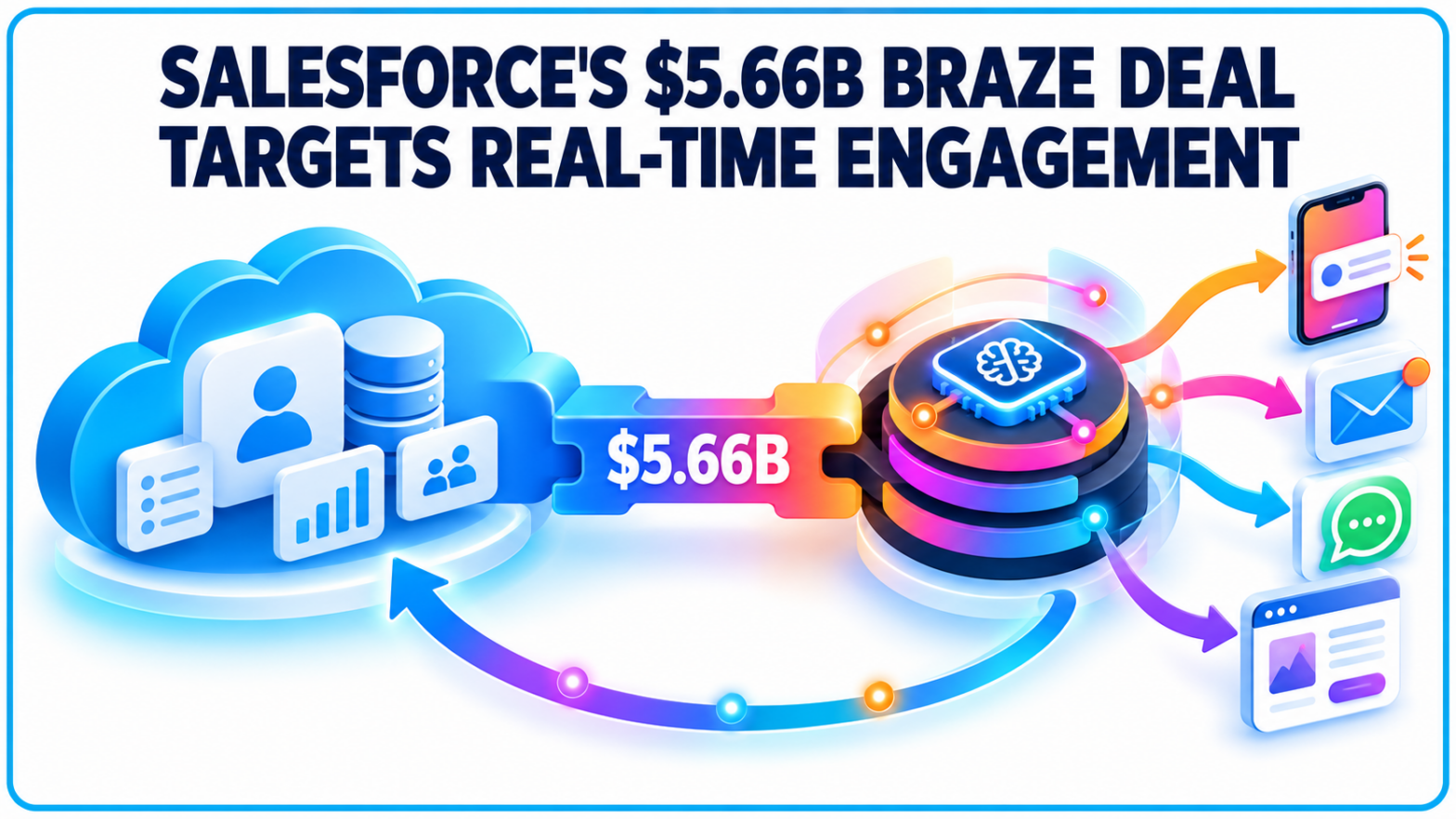
Salesforce already owns the customer record. Its proposed $5.66 billion purchase of Braze is aimed at controlling what happens in the seconds after that record changes.
The all-cash agreement would add Braze’s real-time messaging, mobile engagement and AI decisioning technology to Salesforce Marketing Cloud, Data 360 and Agentforce. The deal is expected to close during Salesforce’s fiscal 2028, subject to shareholder and regulatory approvals.
Salesforce Is Paying for Action, Not Another Customer Database
Salesforce and Braze signed their definitive merger agreement on October 19 and announced the transaction the following day.
Under the agreement, Braze Class A shareholders would receive US$47.50 per share in cash. Salesforce values the transaction at approximately US$5.66 billion on an enterprise-value basis and expects to fund it with cash rather than issuing shares.
Braze would become a wholly owned Salesforce subsidiary after the transaction closes. Its board unanimously approved the agreement, but holders of a majority of the company’s outstanding Class A shares must still vote in favour.
Salesforce does not expect the proposed acquisition to alter its fiscal 2027 guidance. The company has not issued fiscal 2028 guidance or changed its longer-term financial targets.
The acquisition presentation filed with the U.S. Securities and Exchange Commission acknowledges a financial trade-off. Salesforce expects the transaction to contribute to growth while diluting profitability in the near term. It also points to potential revenue gains through Salesforce’s distribution network, increased monetization and operational efficiencies across the combined businesses.
Braze Fills the Gap Between a Signal and a Message
Braze is designed to respond while customer behaviour is still unfolding.
Its event-streaming architecture processes live signals from apps, websites, cloud data warehouses and other connected systems. Marketers can use those signals to adjust customer journeys and deliver messages through email, SMS, WhatsApp, mobile push notifications, in-app experiences, websites and personalized content feeds.
That gives Salesforce something different from a static customer profile.
A CRM may know that a person is a customer, what they bought and which service cases they opened. Braze is built to react when that person browses a product, abandons a task, changes how they use an app or takes another action that may call for an immediate response.
Patrick Stokes, Salesforce’s president of applications and marketing, described that capability directly:
“Braze was built to turn live customer behaviour into personalized engagement at scale.”
BrazeAI adds decisioning across content, offers, channels and timing. Instead of relying only on predetermined journey branches, the platform can help determine which experience should be delivered and when.
Braze currently serves approximately 2,770 customers, including Canva, Dairy Queen, Equinox, Instacart, Urban Outfitters and Venmo. Salesforce says the platform powers trillions of messages and customer-journey actions each year.
Salesforce Wants One Loop From Data to Delivery
Salesforce says Braze would complement four layers of its architecture: Data 360, Customer 360, Agentforce and SIForce.
The intended sequence is straightforward. Data 360 supplies unified information, Customer 360 provides relationship context, Agentforce supports decisions and Braze delivers the resulting experience through customer-facing channels. That interpretation follows the architecture Salesforce presented, although the company has not yet released a detailed technical integration plan.
The deal therefore extends Salesforce’s existing push into AI marketing automation. Agentforce Marketing already positions AI agents as operational participants that can build campaigns, qualify leads, create content and manage customer journeys. Braze would add an established execution layer for high-volume consumer engagement, particularly across mobile and app-based experiences.
The acquisition also supports Salesforce’s larger approach to customer data integration. Braze can activate signals from cloud warehouses and other external platforms rather than requiring every piece of information to be stored in one proprietary system.
Salesforce and Braze are emphasizing an open, composable model. That language fits Salesforce’s broader composable CRM strategy, which exposes data, workflows and business logic through APIs and agent-accessible tools.
Whether that openness survives the practical work of product integration will matter to customers using Braze alongside competing data warehouses, content systems and analytics platforms.
Product Overlap Becomes the Immediate Customer Question
The strategic fit does not eliminate product overlap.
Salesforce Marketing Cloud already supports customer journeys, segmentation, email, mobile messaging and cross-channel personalization. Braze sells many comparable capabilities, with particular strength in mobile-first, real-time consumer engagement.
Salesforce describes the products as complementary. It has not announced which services will be integrated first, whether any overlapping products will be consolidated or how pricing and packaging may change after closing.
Braze co-founder and CEO Bill Magnuson said the company intends to continue building under the Braze name and investing in its customer and partner community. Salesforce has not disclosed Magnuson’s post-closing title, a long-term organizational structure or whether Braze will continue operating as a separately sold platform.
Those unanswered details are more consequential for current customers than the immediate announcement. Enterprises may already have years of customer journeys, consent records, event schemas, identity rules, message templates and integrations built around either platform.
For marketing teams, the practical response is to document those dependencies rather than assume an immediate migration. Existing Braze and Salesforce customers can map their identity resolution, data movement, consent management, orchestration and reporting systems while waiting for a formal product roadmap. The signed agreement alone does not change current contracts or establish a replacement schedule.
The Acquisition Still Has a Long Approval Runway
The closing timeline reaches into Salesforce’s fiscal 2028 and remains subject to several conditions.
According to Braze’s SEC filing, the transaction requires the expiration of the applicable U.S. antitrust waiting period, approvals under specified foreign investment and competition laws, and the absence of an order blocking the merger.
The agreement includes an outside date one year after signing, with two possible extensions of up to 90 days each when additional time is required for regulatory clearance.
Salesforce may owe Braze a US$300 million termination fee under specified circumstances involving regulatory failure. Braze may owe Salesforce US$191.39 million in certain situations, including accepting a superior proposal or failing to secure shareholder approval under the conditions defined in the agreement.
Braze still intends to file preliminary and definitive proxy materials with the SEC before shareholders vote. Until the transaction closes, Braze remains an independent public company trading on Nasdaq under the symbol BRZE.