

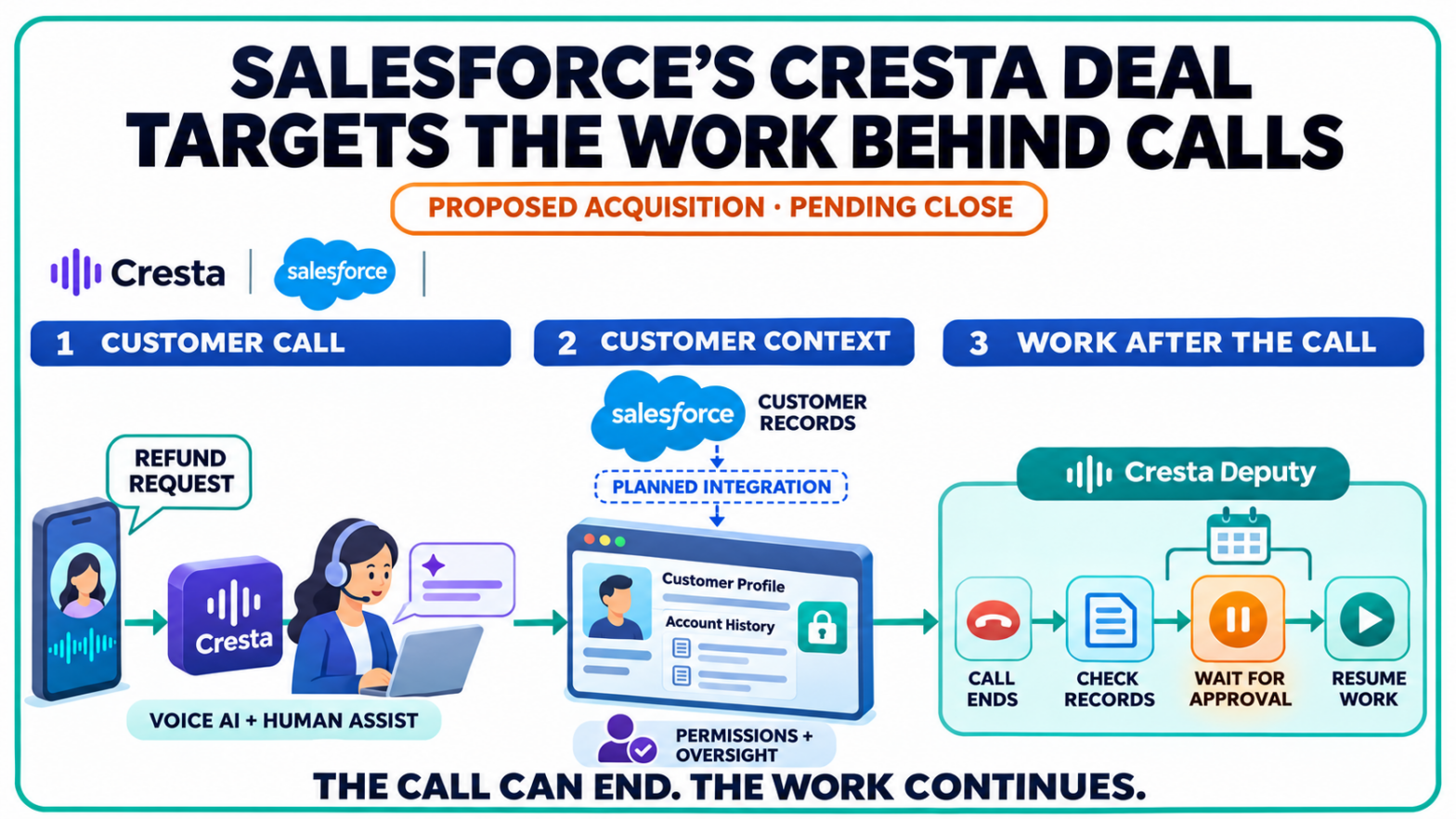
A customer call can end long before the customer’s problem is resolved. Salesforce’s proposed acquisition of Cresta would bring conversational AI, employee assistance and service workflows closer to the customer records behind those interactions.
Salesforce announced a definitive agreement to acquire Cresta on November 2. The announcement did not disclose a purchase price, and the transaction remains subject to closing conditions.
The proposed purchase reaches beyond software that answers incoming calls. Cresta’s existing platform also supports human representatives, supervises live interactions and automates operational work that continues after a conversation ends.
Customer Records Give AI Voice Agents More Context
Salesforce describes the combination as connecting Cresta’s understanding of customer conversations with its customer history and business systems. Service Cloud would provide the service platform linking those conversations to outcomes such as resolution, retention and revenue.
The intended connection addresses a practical limitation of AI voice agents: conducting a fluent conversation is different from resolving the underlying request.
A representative or automated agent may understand that someone wants a refund. Completing that request still requires the right account information, permissions and access to the systems that process it.
That makes customer data integration central to evaluating the proposed combination. The relevant question is not simply whether the software can understand a caller, but whether it can connect that understanding to authorized action.
The acquisition announcement describes that direction. It does not establish that a newly combined product is already available.
Cresta’s AI Customer Service Extends Beyond the Call
Cresta’s recent product releases show how its platform has been expanding beyond live conversations.
On October 13, the company introduced Deputy Agent, a long-running AI agent designed to carry operational workflows across systems and teams. Cresta identifies refund requests, transaction disputes and insurance claim appeals as examples of processes that can require work over days or weeks.
According to the company, Deputy preserves a workflow’s progress when it must wait for documents or approval, then resumes when the necessary information becomes available. Work can begin during a call, through a handoff or from a back-office queue without a customer conversation.
The distinction is relevant to AI customer service because answering a question and completing a request are separate tasks. A conversation may finish successfully while the operational process remains open.
Deputy is an existing Cresta product. Its capabilities provide context for the proposed acquisition, rather than evidence of a completed Salesforce integration.
Human Representatives Remain Part of the Platform
Cresta’s offering is not limited to autonomous agents replacing individual conversations.
Its Agentic Assist product provides human representatives with context-aware guidance, knowledge and automation during customer interactions. The platform includes capabilities for retrieving information, generating summaries and guiding responses.
That employee-facing layer is distinct from an AI agent handling the conversation itself. It keeps a person responsible for the interaction while software supplies information and helps with associated work.
Cresta also offers an Agent Operations Center for supervising human and AI-led conversations in one workspace. The company says supervisors can receive alerts, guide an AI agent’s next response, approve exceptions or take over an interaction.
Those controls make the acquisition relevant to service managers as well as technology buyers. Evaluating automation involves more than the share of calls an agent can handle independently. Escalation, intervention and the visibility available to supervisors also shape how a deployment operates.
The published capabilities describe Cresta’s current platform. They do not guarantee a particular staffing outcome or service improvement for customers of the proposed combined business.
Developer Tools Were Expanding Before the Agreement
Days before Salesforce announced the deal, Cresta opened more of its platform to customer and partner developers.
Its October 29 self-service announcement describes tools for building, testing, deploying and improving customer-facing AI agents. Developers can work through their own code repositories and software release processes using Cresta Conductor.
The release also outlines controlled deployments, comparisons between agent versions, rollback capabilities and separate permissions for builders and reviewers. Cresta’s AI Agent SDK supports custom Python code connecting agents to a company’s systems.
These are deployment controls, not simply conversational features. They govern how changes reach customers and who can approve them.
For marketing and customer-experience teams, the practical implication is to assess service automation against completed customer outcomes, not just call handling. Account-data accuracy, escalation rules, workflow ownership and permission controls remain necessary even when the conversational interface performs well.
Cresta says teams that want implementation assistance can continue working with its forward-deployed engineers alongside the self-service option.
Existing Phone Platforms Remain in Scope
Salesforce says Cresta will continue supporting the leading contact-centre and telephony platforms its customers currently use after the transaction closes.
That commitment is narrower than a guarantee that every integration, commercial term or deployment arrangement will remain unchanged. The acquisition announcement does not provide a detailed combined-product roadmap or new pricing.
Existing Cresta capabilities and a future Salesforce offering therefore remain separate considerations. The agreement establishes an intended change in ownership; it does not, by itself, announce an immediate migration requirement for customers.
Salesforce expects the transaction to close in the first quarter of its fiscal year 2028, subject to customary closing conditions, including required regulatory approvals.