


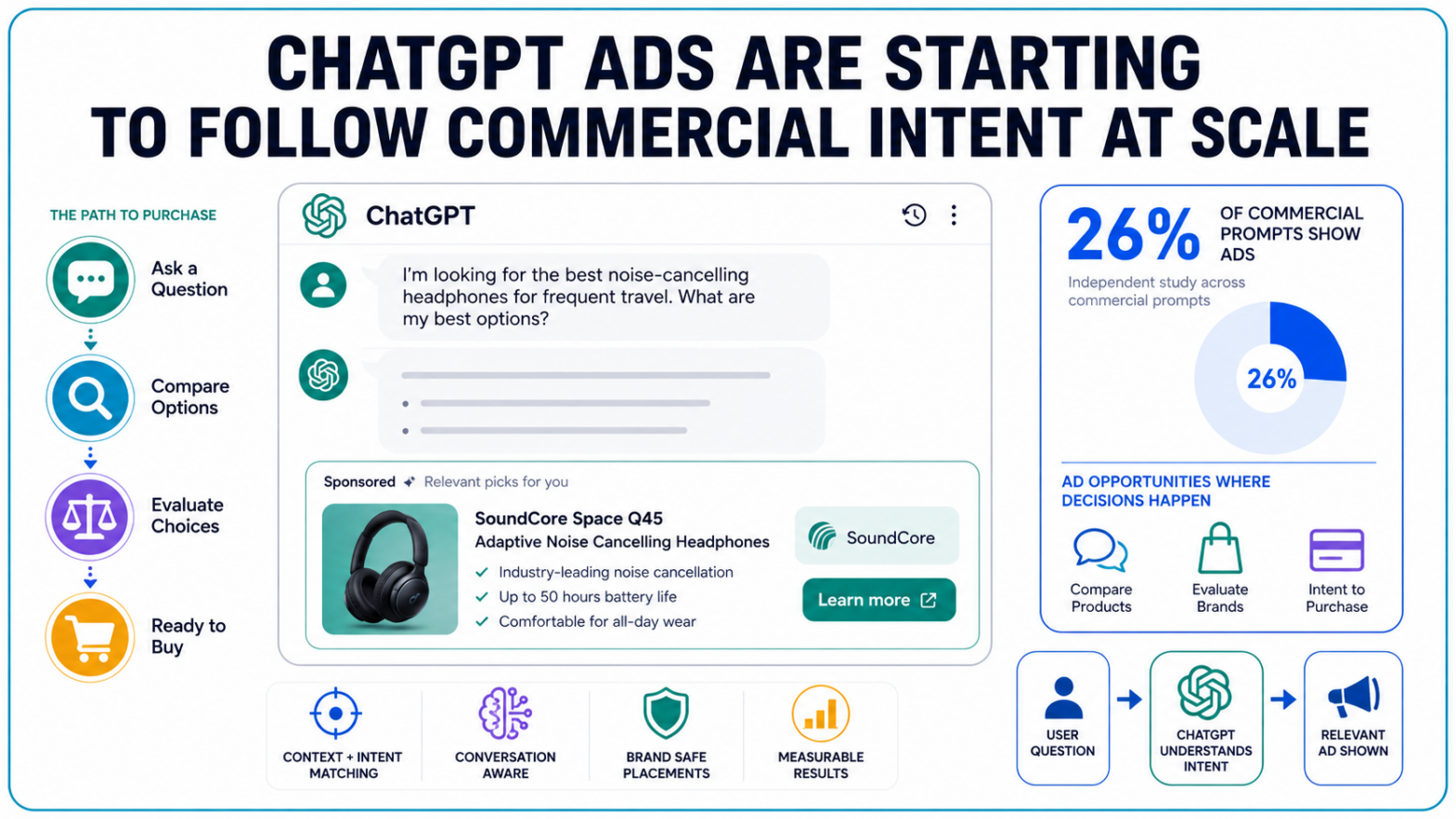
ChatGPT is starting to monetize the part of a conversation advertisers care about most: the moment a user begins weighing what to buy.
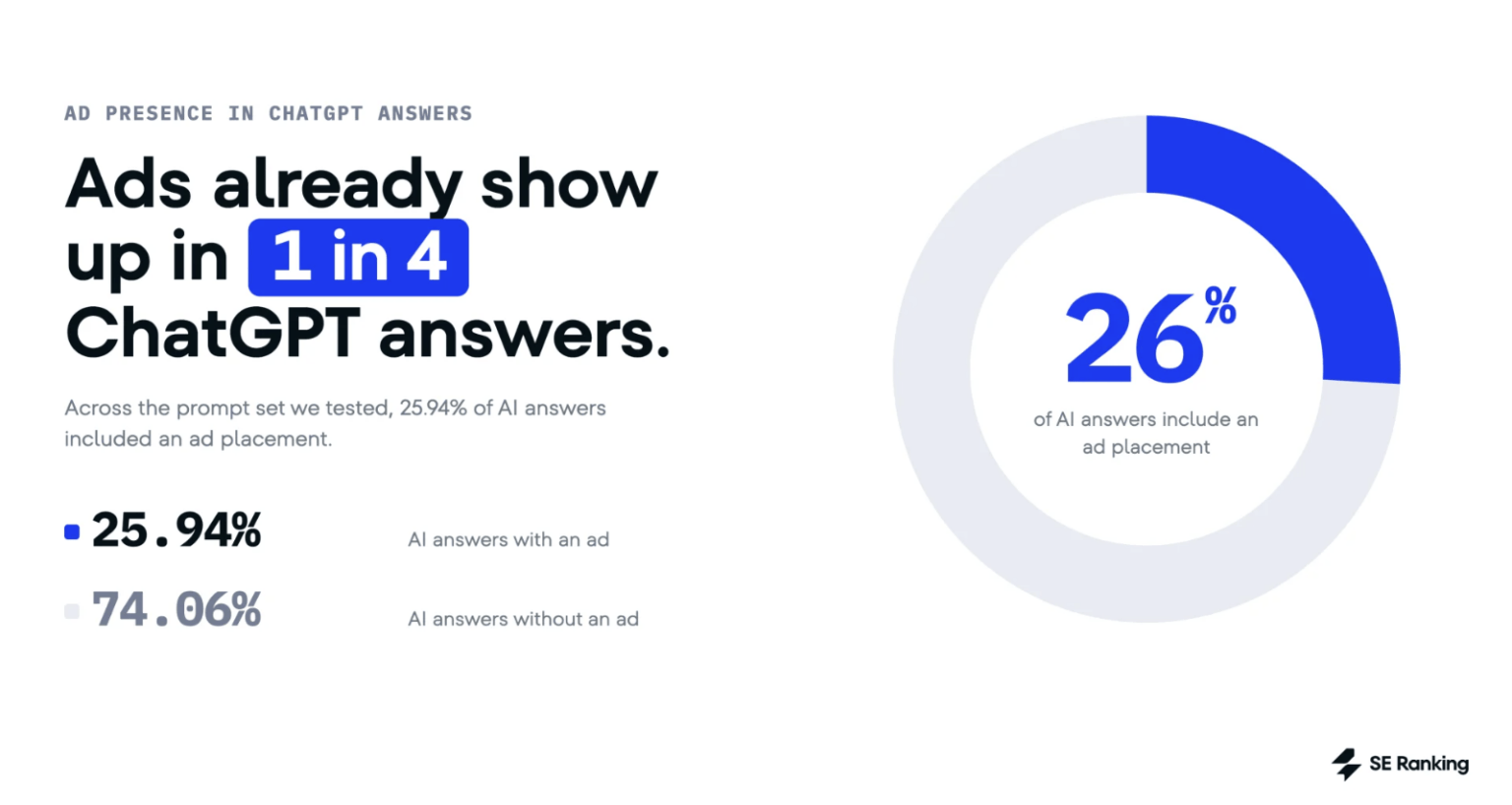
New monitoring data found ads appearing across roughly 26% of commercial prompts, adding to mounting evidence that OpenAI's advertising system is becoming far more active around comparison, recommendation and purchase-oriented conversations.
That is a different advertising problem from filling empty inventory.
It is about recognizing intent.
Commercial Questions Are Becoming ChatGPT's Ad Inventory
Search advertising was built around a fairly simple signal. Someone types a query. The words in that query tell the platform something about what the person wants.
ChatGPT has considerably more context to work with.
A user might begin by asking how to solve a problem, narrow the discussion to several possible products, compare brands and eventually ask which option is best. The commercial signal can emerge gradually rather than appearing as an obvious keyword in the first prompt.
OpenAI's own advertiser documentation says its system evaluates both the context and intent of the current conversation when deciding whether an ad is relevant. The matching process can also consider the advertiser's landing page, headline, ad copy and supplied "context hints."
That helps explain why ChatGPT ads are increasingly interesting to paid media teams.
A commercial prompt does not have to resemble "buy running shoes" to signal buying intent. Someone comparing trail shoes for wet conditions, asking which CRM fits a 20-person sales team or planning a hotel stay for a specific weekend may already be deep into a purchase process.
In conventional search, those needs may be distributed across several individual queries.
Inside ChatGPT, they can exist inside one conversation.
OpenAI Is Matching Ads to Situations, Not Just Keywords
OpenAI's current ad model gives advertisers a field called context hints rather than a traditional keyword list.
That choice says a lot about where the platform is heading.
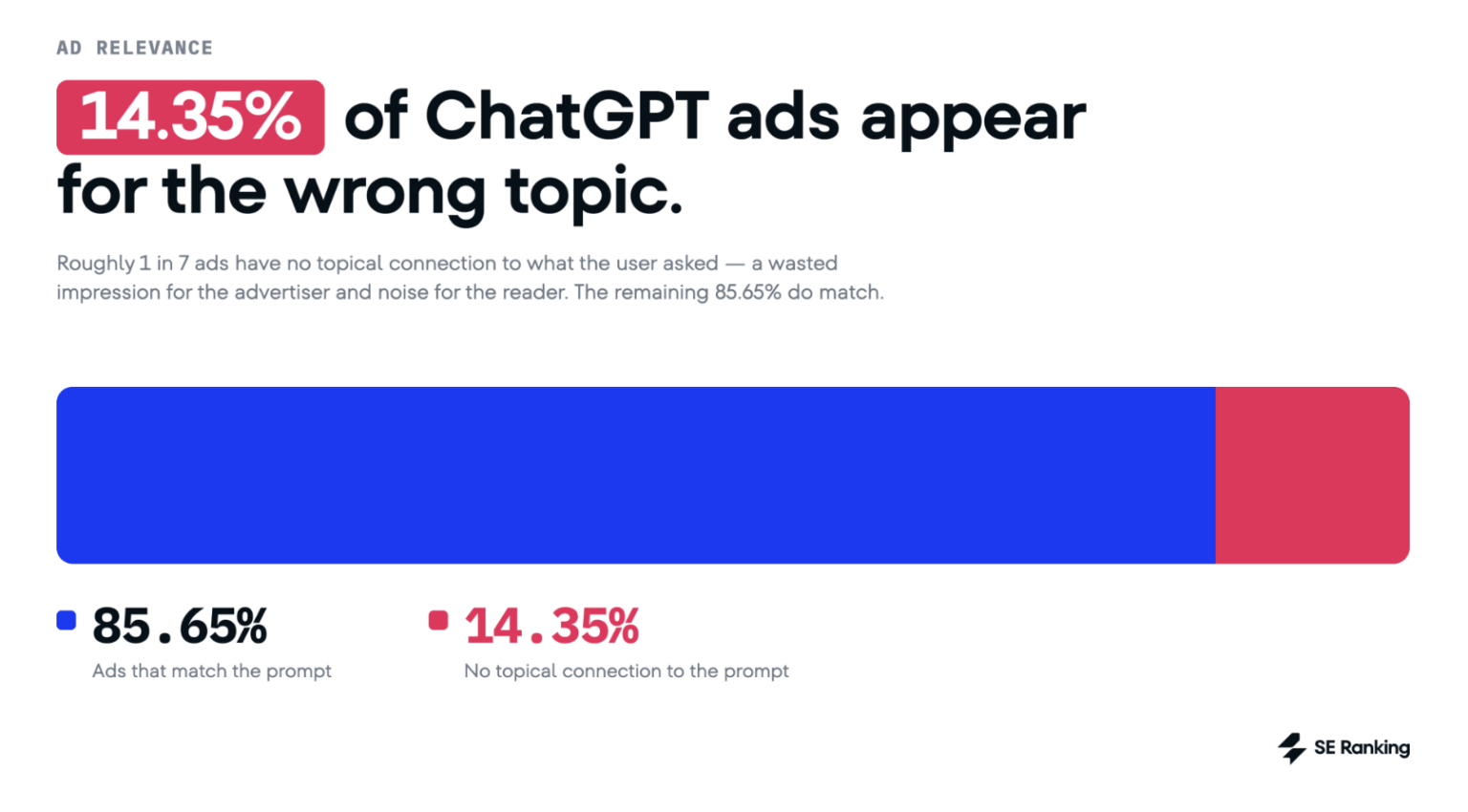
Advertisers describe the type of conversation where an ad should be relevant. OpenAI then determines whether the user's current context matches that description.
The company says its ad-delivery system weighs conversation context alongside the advertiser's creative and destination. When ad personalization is enabled, additional signals from a user's broader ChatGPT experience may also contribute to ad selection.
OpenAI still draws a firm line between advertising and its answers. Sponsored placements appear separately below relevant ChatGPT conversations, and the company says ads do not influence what ChatGPT says.
That separation matters as conversational advertising moves deeper into the buying journey.
An ad that appears after someone asks for help comparing three accounting platforms is adjacent to a recommendation environment. Even if the sponsored placement has no influence over the response above it, the advertiser is entering the conversation at a moment when the user is actively evaluating alternatives.
OpenAI's policies also restrict where that opportunity exists.
The company does not place ads beside conversations it classifies as sensitive or brand unsafe. Its current advertising policy specifically limits placements around personal, high-stakes or emotionally vulnerable contexts, while other prohibited categories remain restricted.
The inventory is therefore shaped by two filters: commercial relevance and suitability.
A 26% Ad Rate Still Does Not Mean Every Buyer Sees One
Ad-frequency studies need careful interpretation.
ChatGPT's ad programme is still evolving quickly, and independent measurements have produced sharply different rates depending on geography, account eligibility, industry, prompt selection and the date the test was conducted.
A 26% rate across commercial prompts should therefore be read as evidence of meaningful ad penetration in the measured sample, not as a platform-wide guarantee that one in four commercial conversations will contain an ad.
Other independent datasets illustrate the volatility.
Cloro's monitoring recorded ads in 26.5% of responses during a May 26 measurement, with the U.S. rate reaching 49.1%. After ad delivery fell again in June, its updated July data recorded ads across 51% of U.S. responses, 53.6% in Canada and 49.8% in Australia.
Another longitudinal test by Rank Fuse followed the same 101 B2B HR prompts for 46 days. Its ad rate moved from virtually zero in early June to more than 80% on most days during the first half of July.
Different methodology, different numbers.
The common thread is harder to ignore: ChatGPT ad delivery can expand rapidly once OpenAI activates inventory for a market and category.
OpenAI itself describes the programme as a test whose availability and behaviour will continue to evolve. Ads currently apply to eligible users on Free and Go plans rather than Plus, Pro, Business, Enterprise and Edu accounts.
That eligibility alone can produce large differences between an advertiser's theoretical audience and the number of conversations where an ad can actually appear.
ChatGPT Ads Are Moving Past the Experimental Phase
The ad product surrounding those placements has also become much more developed.
OpenAI has moved from an early controlled test to self-serve campaign buying, CPC pricing, conversion measurement and broader advertiser access. TechWyse previously covered the launch of its self-serve ChatGPT Ads Manager, which gave businesses a direct route into campaign creation and measurement.
More layers followed.
Advertisers can now use first-party customer and prospect lists through ChatGPT custom audiences, adding another targeting signal alongside conversational context.
Retailers have also gained product-feed campaigns capable of turning catalogue data into ads at scale.
Those additions make the 26% finding more significant than an isolated ad-frequency statistic.
OpenAI is building both sides of the marketplace at the same time. More conversations are becoming eligible ad opportunities while advertisers receive more ways to buy, target, measure and populate those placements.
The result looks increasingly like an advertising platform rather than an experimental sponsored unit attached to a chatbot.
Paid and Organic Visibility Now Share the Same Conversation
For marketers, the practical change is that commercial visibility inside ChatGPT can no longer be treated purely as an organic AI-search question.
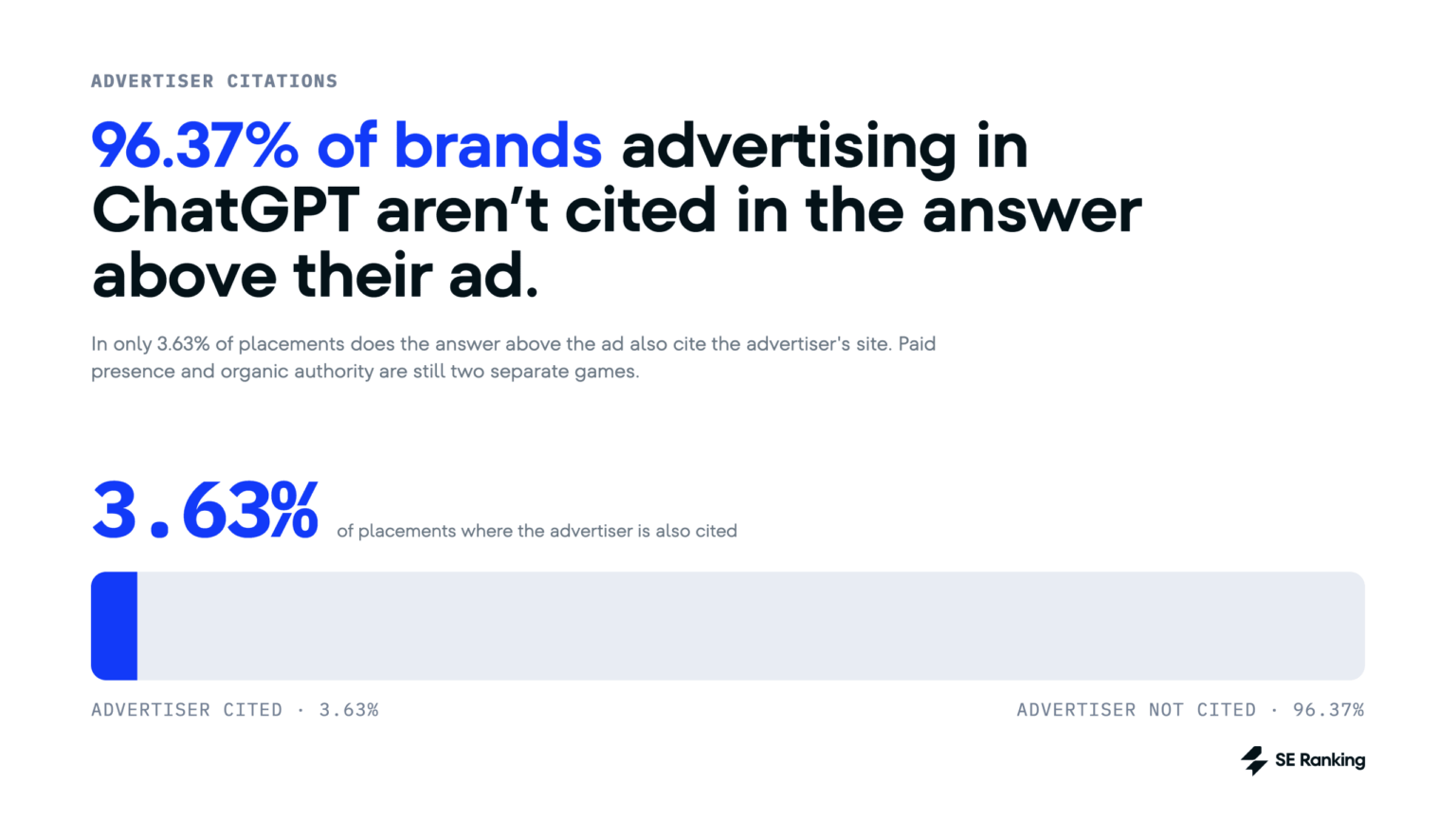
A brand could appear in the generated response. A competitor could appear in the sponsored placement immediately below it. A company could also have neither position.
Those are separate systems.
OpenAI explicitly states that buying ads does not affect ChatGPT's answers, so paid placement should not be treated as a route to greater organic recommendation or citation visibility. Advertisers are buying access to an adjacent commercial surface, not influence over the model's response.
In practice, paid media teams will need to evaluate which conversational themes actually produce inventory rather than assuming every commercially relevant prompt behaves like a search keyword. Prompt-level ad frequency, geography, campaign delivery and conversion data all matter, particularly while OpenAI continues changing how aggressively ads are served.
Commercial intent is becoming measurable inventory inside AI conversations.
The open question is no longer whether ChatGPT can show ads when someone is deciding what to buy. OpenAI has already crossed that threshold. The remaining variable is how consistently it chooses to monetize those moments.